This guide covers Kitchenaid Washer Not Draining Or with practical, technician-backed advice.
A KitchenAid washer that finishes its cycle with water still standing in the drum, or that agitates but never spins, most often has a clogged or failed drain pump, a lid switch or door lock assembly that’s preventing spin as a safety measure, a worn or broken drive belt, or a clogged coin trap catching debris before it reaches the pump. The distinction between ‘won’t drain’ and ‘won’t spin’ narrows this down quickly.
Understanding the Kitchenaid Washer Not Draining Or
Below, our specialists break down everything you need to know about the Kitchenaid Washer Not Draining Or.
Drain Pump Clogs and Failures
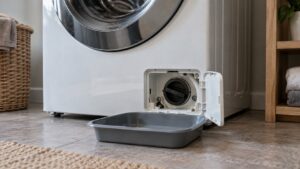
Small items like coins, buttons, bra underwires, and bobby pins regularly find their way into the drain pump housing, where they can jam the impeller or damage it outright. A pump that hums loudly without moving water usually has debris lodged inside, while a completely silent pump during the drain portion of the cycle suggests a burned-out motor or a wiring failure. Many KitchenAid washers have an accessible coin trap or debris filter near the pump specifically designed to catch these items before they cause damage, and checking it is often the fastest fix.
Lid Switch and Door Lock Safety Interlocks
Both top-load and front-load KitchenAid washers use a switch that confirms the lid or door is securely closed before allowing the drum to spin, as a safety measure to prevent injury from an open, spinning drum. If this switch fails, the washer can agitate and even attempt to drain but will refuse to spin at all, since the control board interprets the lid as open regardless of actual position. This is one of the more common reasons for a washer that seems to do ‘everything except spin.’
Drive Belt Wear (Top-Load Washers)
Many top-load KitchenAid washers use a belt to transfer motor power to the drum and pump. A worn, stretched, or snapped belt can cause the drum to agitate weakly or not spin at all, sometimes accompanied by a burning rubber smell if the belt is slipping under load rather than fully broken. Front-load washers with direct-drive motors don’t have this failure point, so this cause applies mainly to top-load models.
Unbalanced Load Detection
Modern washers include sensors that detect an unbalanced load and will refuse to spin at full speed, or pause mid-cycle, to prevent the machine from walking or damaging itself. If the washer eventually resumes spinning after you redistribute a heavy, bunched-up load like a comforter, this safety feature rather than a mechanical problem is likely responsible.
Diagnostic Steps
- Check the coin trap or debris filter near the pump for lodged small items.
- Confirm the lid or door latches fully and audibly.
- Redistribute an unbalanced load and restart the spin cycle to rule out load-balance protection.
- Listen for pump humming versus silence during the drain portion of the cycle.
Front-Load vs Top-Load Diagnostic Differences
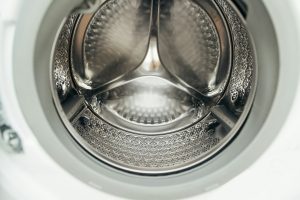
Front-load KitchenAid washers use a door boot seal instead of a lid, and debris can also lodge in the folds of that boot seal, occasionally interfering with the door lock sensor in a way that mimics a lock failure. Checking inside the boot seal folds for coins or small items is worth doing on front-load models specifically before assuming the door lock assembly itself has failed, since the fix in that case is simply removing the obstruction rather than replacing a part.
High-Efficiency Detergent and Buildup
Using more detergent than a high-efficiency washer needs, or using non-HE detergent that produces excess suds, can leave residue buildup inside the pump housing and drain path over time. This buildup gradually restricts flow in ways that mimic a failing pump even though the motor itself is perfectly healthy, and running an empty hot-water cycle with a washer-safe cleaning tablet periodically helps prevent this residue from accumulating to the point of causing drainage complaints.
Getting a Technician Out
Pump, belt, and lid switch replacements all require partial disassembly of the washer cabinet, which is straightforward for an experienced technician but risky without the right tools. Our team stocks these components from trusted parts suppliers for most KitchenAid washer models. Compare typical repair scope in our washer repair cost guide, check compatibility on our models page, and schedule a repair visit. Manufacturer specs are at kitchenaid.com.