An ice maker that slows down, jams, or stops producing altogether is one of the more frustrating small failures in a kitchen, mostly because the cause is rarely obvious from the outside. Between the water fill system, the freezing cycle, and the mechanical harvest, a KitchenAid ice maker repair really is a multi-system diagnosis rather than a single fix, which is why our independent specialist technicians work through each stage methodically.
Common KitchenAid ice maker problems
The most frequent call we get is simply no ice at all, which can mean the fill tube has frozen shut, the water inlet valve has failed, or the harvest motor has stopped responding. A close second is output that has gradually slipped — half the ice it used to make, or cubes that come out small and hollow — which often traces back to a weak thermistor or scale buildup inside the fill lines. Standalone and undercounter units add compressor and refrigerant concerns to the mix, since these are self-contained cooling appliances rather than just a water-and-freeze mechanism bolted onto a refrigerator.
Our KitchenAid ice maker repair process
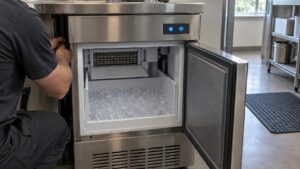
We begin by isolating which stage of the cycle is failing: fill, freeze, or harvest. That means checking water pressure and the inlet valve first, then testing the thermistor and module timing, and finally inspecting the harvest motor or auger for mechanical binding. On standalone units we also check compressor function and refrigerant-side performance before touching the water system. Once the failing part is confirmed, we replace it using components from trusted parts suppliers and run a full ice-making cycle on-site to confirm the fix holds. Every KitchenAid ice maker repair we complete includes a labor guarantee, so the visit isn’t done until ice is actually coming out consistently.
KitchenAid ice maker models we service
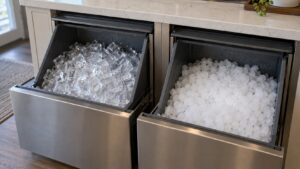
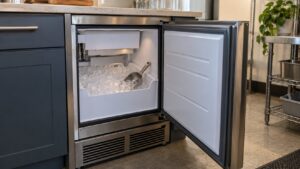
We repair the ice makers built into KitchenAid ExtraLarge capacity refrigerators as well as freestanding ice maker drawers and undercounter clear-ice units. Built-in models typically share a water line and control logic with the refrigerator, while standalone units run their own self-contained refrigeration circuit — two very different repair paths that our technicians are equally comfortable with. If you’re not sure which category your unit falls into, our model guide can help before your appointment.
Error codes and diagnostics
Modern KitchenAid ice makers display short alerts tied to specific failures. NO-ICE flags a stalled production cycle, HI warns that interior temperature is running too high to freeze properly, FL indicates the water fill has timed out, DR points to a drain problem, and CP signals a compressor failure on standalone units. CL requests a cleaning cycle, while numeric codes such as E1 through E5 cover cooling problems, damper cycling issues, heater or thermistor timeouts, a full ice bin, and timed ice-making problems respectively, and Er indicates a communication failure between components. Our error code directory lays these out individually, and our maintenance guides cover filter changes and line flushing that prevent several of these from recurring.
Service areas
We serve homes and small businesses across the metro area and nearby communities, with scheduling flexible enough to accommodate restaurants and bars that can’t afford extended ice maker downtime. Visit our service locations page to confirm coverage, then book your repair online. For general product specifications, KitchenAid’s site at kitchenaid.com is a useful supplementary resource.
We also see a fair number of calls where the ice maker itself is fine but the water supply feeding it isn’t — a kinked line, a nearly-closed shutoff valve, or a saturated filter can mimic a fill valve failure closely enough that ruling out the water source first saves an unnecessary parts replacement. For commercial accounts running an undercounter unit daily, we can also set up a recurring maintenance visit that catches scale buildup and worn gaskets before they turn into a full breakdown during business hours.
We keep a stock of common fill valves and drain pumps on hand specifically because ice maker calls are frequent enough to warrant it, which shortens the wait between diagnosis and a completed repair in most cases.