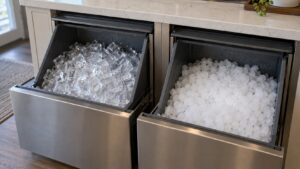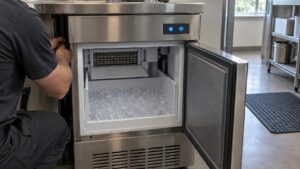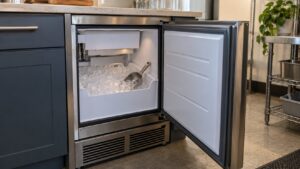
KitchenAid ice maker repair costs are shaped by whether the failure is a simple part — like a water inlet valve or a fill tube — or a more complex issue involving the ice maker module, the auger motor on models with an internal ice bin, or the control board that governs the freeze cycle. Straightforward mechanical repairs tend to be the most affordable, while electronic module and sealed-system related issues sit at the higher end. Because so many ice maker problems share the same basic symptom — no ice, slow ice, or ice that tastes off — an accurate quote depends on identifying the actual cause first.
Understanding the Kitchenaid Ice Maker Repair Costs
Below, our specialists break down everything you need to know about the Kitchenaid Ice Maker Repair Costs.
What Determines Ice Maker Repair Pricing
Ice maker repair costs come down to the part needed and the access required to install it. On a refrigerator with a built-in ice maker, some components like the water filter or the fill tube are accessible from the front, while others like the ice maker module itself may require partially disassembling the freezer interior or removing panels to reach the back of the compartment. On models with a standalone ice maker unit, such as an under-counter ice machine, the repair may involve accessing the compressor compartment, which adds complexity compared to a simple module swap.
Common Repairs and Cost Ranges
Lower-cost repairs from $ typically include water inlet valve replacement, fill tube unclogging or replacement, and ice maker arm or sensor bar issues that can sometimes be resolved with a simple part swap. Mid-range repairs from $ often involve the ice maker module itself, thermostat replacement, or auger motor repairs on models with a built-in ice storage bin and dispenser. Higher-cost repairs from $ usually point to sealed-system issues affecting the freezer’s ability to reach ice-making temperature, compressor-related problems, or a full control board replacement governing the automatic ice-making cycle.
Why Diagnosis Matters More With Ice Makers
An ice maker that stops producing ice can have a cause completely unrelated to the ice maker itself. If the freezer compartment is not reaching the correct temperature, the ice maker will never cycle properly regardless of how new or well-maintained the module is — in that case, the real issue could be a failing evaporator fan, a blocked air vent, or even a refrigerant issue in the sealed system. Replacing the ice maker module in this scenario wastes money and does not solve the underlying problem. A proper diagnostic checks freezer temperature, water pressure and flow to the unit, and the ice maker’s electrical signals before recommending a specific part.
Water Quality and Line Issues That Add Cost
Ice makers depend on a consistent water supply, and problems upstream of the appliance can masquerade as ice maker failures. A partially closed shutoff valve, a kinked water line, or a heavily saturated inline water filter can all restrict flow enough to cause slow ice production or a completely stalled ice maker. In some cases, the water line itself, especially older plastic tubing that has become brittle, may need replacement as part of the repair, which adds a modest cost but prevents a future leak. Hard water areas may also see faster mineral buildup in the fill valve and tubing, which is worth mentioning to your technician if you have had repeated ice maker issues.
How Regular Use Affects Ice Maker Longevity
Ice makers that run constantly in high-demand households, such as during summer months or when hosting frequently, cycle through their fill-freeze-harvest process far more often than one used lightly. This added cycling accelerates wear on the fill valve, the ice maker arm or optical sensor, and the module’s internal gearing. Periodically replacing the water filter on schedule, rather than waiting until flow noticeably slows, also helps protect the fill valve from mineral scale that can otherwise force it to work harder and fail sooner. None of this eliminates the need for repair over the appliance’s lifetime, but it does spread out failures and often keeps the most expensive components running longer.
Scheduling an Accurate Estimate
Because so many possible causes can produce the same "no ice" symptom, the fastest way to a reliable number is a diagnostic visit rather than a phone quote. Our technicians test water flow, freezer temperature, and the ice maker’s internal components before recommending a specific repair. For related troubleshooting, see our ice maker not making ice guide and our refrigerator repair-or-replace guide if the ice maker issue is one of several problems with an aging unit. KitchenAid’s current refrigeration lineup and ice maker features are detailed at kitchenaid.com.