This overview covers Kitchenaid Ice Makers — the lineup, signature technologies, common problems, and upkeep.
Ice makers are one of the more mechanically active parts of a modern kitchen, cycling through fill, freeze, and harvest dozens of times a day, and KitchenAid’s versions span everything from a refrigerator drawer accessory to a full standalone appliance. Owners who understand the differences tend to get more trouble-free years out of theirs.
Understanding the Kitchenaid Ice Makers
Below, our specialists break down everything you need to know about the Kitchenaid Ice Makers.
The three forms an ice maker takes
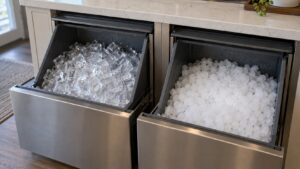
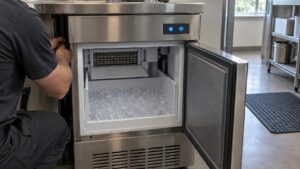
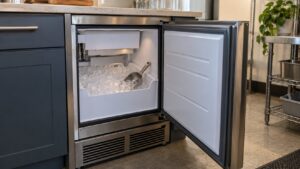
Most households have a KitchenAid ice maker as an integrated feature of an ExtraLarge capacity refrigerator, tucked into the freezer compartment or door and fed by the home’s water line. A smaller but growing group of owners have a freestanding ice maker drawer built into cabinetry, functioning as its own appliance with a dedicated water connection. A third category, undercounter clear-ice units, produces slower-melting, restaurant-style cubes through a longer freezing cycle and is increasingly common in home bars and outdoor kitchens. Each has a genuinely different mechanical layout, which matters the moment something stops working correctly.
Why clear ice takes longer to make
Standard refrigerator ice makers freeze water quickly from all directions, which traps air and minerals inside the cube and produces the cloudy appearance most people are used to. Clear-ice units instead freeze from the bottom up in slow layers, pushing trapped air and impurities to the top of a shallow water reservoir before it fully freezes, then harvesting a nearly transparent cube. That process takes considerably longer per batch, which is a normal characteristic of the design rather than a sign of a slow or failing unit — a distinction worth knowing before assuming something’s wrong with a new clear-ice appliance.
The parts that wear out first
Across all three formats, the water inlet valve is usually the first component to show its age, since mineral content in tap water gradually restricts the small orifice that controls fill volume, leading to smaller or slower-forming cubes long before the valve fails outright. The harvest mechanism — a rotating tray or ejector arm depending on the model — is the next most common wear point, particularly if cubes are occasionally allowed to fuse together into a clump that strains the motor during release. On standalone and undercounter units, the compressor and its refrigerant circuit are additional components simply absent from a refrigerator’s built-in ice maker, giving those appliances one more system that can eventually need attention.
Simple upkeep that actually matters
Replacing the water filter on schedule does more for ice maker longevity than most owners realize, since scale buildup from an old filter is a major contributor to both slow fill valves and cloudy or off-tasting ice. Emptying and briefly air-drying the ice bin every couple of months prevents cubes from fusing into a block that jams the harvest mechanism. On standalone units, keeping the surrounding cabinetry ventilated matters more than people expect, since these units generate heat that a built-in refrigerator dissipates differently. If output has already slowed or stopped, our ice maker repair service walks through what a diagnostic visit covers, and our guides section has filter-change and cleaning-cycle instructions specific to different models. For current model specifications, KitchenAid’s site at kitchenaid.com lists capacity and cycle-time details across its ice maker range.
Repair versus replacement
Because a built-in refrigerator ice maker is a relatively small, modular assembly, replacing the entire ice maker unit is often more cost-effective than chasing an intermittent problem across multiple components — a calculus that’s different from most other appliance repairs. Standalone and undercounter units, being full appliances in their own right, are usually worth repairing unless the compressor itself has failed on a unit already several years old.
Owners comparing a built-in refrigerator ice maker against adding a standalone unit should also factor in noise, since standalone compressors run more continuously than the intermittent cycle of a refrigerator’s shared cooling system.
Water quality plays a bigger role than most owners assume across all three formats, since hard water accelerates scale buildup in fill valves regardless of whether the appliance is built-in, freestanding, or a dedicated clear-ice unit, which is part of why a working inline filter is worth checking whenever output starts to slip.