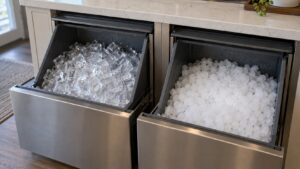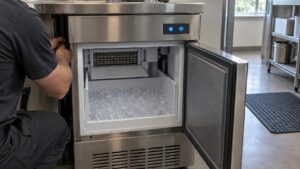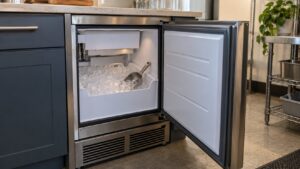

Most KitchenAid ice makers are worth repairing if the unit is under eight years old and the failure is isolated to a single part, such as the water inlet valve, the ice maker module, or a clogged fill tube — replacement only makes financial sense when the compressor has failed on a standalone unit or when repeated repairs have already exceeded half the cost of a new machine.
How KitchenAid Ice Makers Fail
Whether it’s the icemaker built into a French door refrigerator or a standalone KitchenAid ice maker in a wet bar, the failure points are fairly predictable. A unit that stops producing ice entirely often has a frozen or faulty water inlet valve, a bad ice maker module, or a blocked water line. A unit that produces small, hollow, or oddly shaped cubes usually has a water pressure or fill-time problem rather than a failed component. Our specialist technicians see these two categories most often, and they lead to very different repair-or-replace decisions.
When Repair Makes Sense
If your ice maker is less than eight years old, repair is almost always the better value. Water inlet valves, ice maker assemblies, and thermostats are inexpensive relative to the cost of a whole new appliance, and swapping them typically restores full ice production in a single visit. If you’re also seeing water pooling under the unit, read our refrigerator repair cost guide for context on how ice maker repairs compare to other common refrigerator fixes, since the ice maker is often diagnosed alongside broader cooling issues.
When Replacement Wins
Replacement becomes the smarter move in a few specific situations: the sealed refrigeration system on a standalone ice maker has failed (a sealed-system repair rivals the cost of a new unit), the machine is well past its typical 10-12 year service life, or you’ve already paid for two separate repairs in the past two years. For built-in refrigerator ice makers, a failing compressor is a whole-refrigerator problem, not just an ice maker one — at that point the math shifts toward replacing the refrigerator rather than the ice maker component alone.
Cost Factors That Tip the Decision
Several factors influence what a repair will run: whether the part is a common stocked item or a less common module, whether the unit is built-in (harder to access) or standalone (easier), and whether the problem is electrical or mechanical. Diagnostic time also matters — intermittent ice production issues can take longer to isolate than a total production stoppage. Ask your technician for a firm quote after diagnosis rather than a phone estimate, since ice maker issues frequently have more than one contributing cause.
Getting a Second Opinion
Because ice maker repairs are relatively affordable compared to full appliance replacement, it’s worth having an experienced technician diagnose the actual problem before assuming the worst. A clogged filter or kinked water line can look identical to a failed module from the outside, and that distinction is the difference between a minor fix and a full unit swap. Our technicians provide transparent diagnostics before any work begins, so you know which category your repair falls into.
Maintaining Your Ice Maker Going Forward
Once repaired or replaced, a few habits extend the life of any KitchenAid ice maker: change the water filter on schedule, keep the unit’s condenser coils (if standalone) free of dust, and avoid letting the bin overfill and jam the auger. For general upkeep guidance across your kitchen appliances, see our appliance maintenance schedule. For manufacturer specifications and current KitchenAid ice maker models, visit KitchenAid’s official site.
Signs It’s Time to Stop Repairing
A useful rule of thumb: if you’ve replaced the water inlet valve once and the ice maker module a second time within a couple of years, that pattern of repeated failures is often a sign of a deeper issue, such as inconsistent household water pressure or an aging control board elsewhere in the appliance, and it’s worth weighing full replacement rather than continuing to chase individual part failures one at a time.