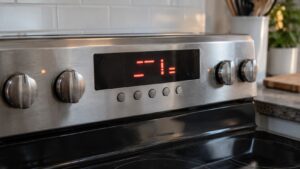
This guide explains the Kitchenaid Range F3 E1 Error: what it means, what causes it, and how to resolve it safely.
This guide explains the Kitchenaid F3 E1 Error 2: what it means, what causes it, and how to resolve it safely.
Understanding the Kitchenaid Range F3 E1 Error
Below, our specialists break down everything you need to know about the Kitchenaid Range F3 E1 Error.
Understanding the Kitchenaid F3 E1 Error 2
Below, our specialists break down everything you need to know about the Kitchenaid F3 E1 Error 2.
What F3 E1 means on your KitchenAid Range
F3 E1 is the shorthand a KitchenAid range uses when its control logic determines that the control board reads a shorted oven temperature sensor circuit, which reports an impossibly low resistance value. The board interprets this as a dangerously high temperature reading and immediately disables the heating elements as a safety measure. The short version, sometimes shown on diagnostic mode as “Oven Sensor Short Circuit”, is oven sensor short circuit.
For anyone trying to gauge urgency, a KitchenAid F3 E1 error falls into a well-documented category of problems that independent appliance technicians diagnose routinely, without needing dealer-only tools. F3 E1 is a hardware short — a breaker reset will not change the sensor’s resistance. The code will reappear immediately after every reset until the shorted component is replaced.
Symptoms
- The control panel displays the F3 E1 error code and refuses to clear with normal button presses.
- The code returns immediately after every power cycle because the problem is a hardware condition, not a software hiccup.
- Related symptoms can include the specific issue described by “Internally shorted RTD temperature sensor” — the resistance element inside the sensor probe has shorted, dropping resistance far below the normal 1,080-ohm baseline and driving the control’s temperature reading into an error state.
- Cooking or heating functions tied to this problem (oven sensor short circuit) are locked out until the code is resolved.
- In some cases you’ll also notice signs pointing toward “moisture intrusion into the sensor connector”.
Common causes
Three failure paths typically explain a F3 E1 reading on a KitchenAid range:
- Internally shorted RTD temperature sensor. The resistance element inside the sensor probe has shorted, dropping resistance far below the normal 1,080-ohm baseline and driving the control’s temperature reading into an error state. This is sometimes something you can check yourself first.
- Pinched or melted sensor wire harness. Two adjacent wires in the sensor harness have had their insulation damaged by heat, causing them to contact each other and create a low-resistance short. This is sometimes something you can check yourself first.
- Moisture intrusion into the sensor connector. Water or cleaning solution entering the sensor harness connector bridges the two terminals and produces a false low-resistance reading. This is sometimes something you can check yourself first.
Troubleshooting steps you can try
These diagnostic steps require no special tools and are safe to perform on a range. Complete them in order and note what changes after each one.
- Measure sensor resistance for a short. With the range unplugged, disconnect the sensor harness and measure resistance across the sensor terminals. A shorted sensor reads near 0 ohms or well below 500 ohms — far from the normal 1,080 ohms at room temperature. Also measure resistance between each sensor wire and the oven cavity metal (chassis ground). Any reading below 1 megohm suggests the harness insulation is compromised.
- Inspect the harness for heat damage near the oven cavity wall. Trace the harness from the sensor probe to where it exits the oven cavity. Look for melted, discolored, or pinched insulation, especially near broiler element brackets or the cavity floor seam. A pinched harness at the cavity wall pass-through is a known failure point on KitchenAid slide-in models after heavy broiling use.
When to call a technician
Bring in a specialist for your range if any of the following apply:
- Harness damage is embedded in the oven cavity wall and requires panel removal
- Sensor replacement does not clear the problem — indicates a board input circuit failure
If the range keeps reporting F3 E1, it is time for an experienced technician. Schedule your repair online, check other error codes, or find specs at kitchenaid.com.