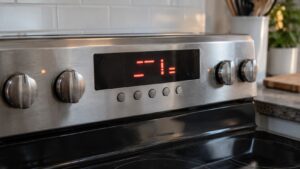
This guide explains the Kitchenaid Range F7 E1 Error: what it means, what causes it, and how to resolve it safely.
This guide explains the Kitchenaid F7 E1 Error 2: what it means, what causes it, and how to resolve it safely.
Understanding the Kitchenaid Range F7 E1 Error
Below, our specialists break down everything you need to know about the Kitchenaid Range F7 E1 Error.
Understanding the Kitchenaid F7 E1 Error 2
Below, our specialists break down everything you need to know about the Kitchenaid F7 E1 Error 2.
What F7 E1 means on your KitchenAid Range
When a KitchenAid range flashes F7 E1, the control board is telling you the control board detects that the relay controlling the lower bake element is stuck in the closed (energized) position. Current continues to flow to the element even after the control attempts to open the relay, creating a runaway heating risk. In plain terms, relay stuck — bake element is what’s happening behind the scenes.
Rather than treating the KitchenAid F7 E1 error as a mystery, think of it as a diagnostic shortcut: the board has already isolated the problem to one circuit or mechanism, which narrows what our independent technicians need to inspect. A breaker reset does not repair welded relay contacts. The element will resume heating immediately when power is restored. Board replacement is required before the range is safe to operate.
Symptoms
- The control panel displays the F7 E1 error code and refuses to clear with normal button presses.
- The code returns immediately after every power cycle because the problem is a hardware condition, not a software hiccup.
- Related symptoms can include the specific issue described by “Welded relay contacts on the control board” — high inrush current when the bake element switches on has welded the relay’s internal contacts together, preventing them from opening when the board commands it.
- Cooking or heating functions tied to this problem (relay stuck — bake element) are locked out until the code is resolved.
- In some cases you’ll also notice signs pointing toward “high-resistance bake element causing overcurrent relay stress”.
Common causes
The following causes account for nearly every case of F7 E1 we see on KitchenAid ranges:
- Welded relay contacts on the control board. High inrush current when the bake element switches on has welded the relay’s internal contacts together, preventing them from opening when the board commands it. This typically requires a technician to resolve.
- Failed relay driver circuit on the control board. The transistor or triac that drives the relay coil has failed in the on-state, continuously energizing the relay regardless of what the software commands. This typically requires a technician to resolve.
- High-resistance bake element causing overcurrent relay stress. An element that is beginning to fail can draw abnormal current spikes that accelerate relay contact welding over time. This is sometimes something you can check yourself first.
Troubleshooting steps you can try
Work through these checks in order — each is safe for a homeowner and helps narrow down what is causing the problem on your KitchenAid range before you call anyone.
- Immediately cut power at the breaker. If the oven is heating uncontrollably, go directly to the circuit breaker panel and switch off the range breaker. Do not attempt to use the oven control panel — a stuck relay will not respond to Cancel. Do not restore power until the oven has been serviced. A welded relay is a fire hazard if the oven is left running unattended.
- Confirm the element stops heating after breaker trip. After switching the breaker off, wait five minutes and briefly restore power. If the bake element glows orange within seconds of power restoration — before any key is pressed — the relay is confirmed stuck. This test is observation only — cut the breaker again immediately if the element begins heating and schedule professional service before any further use.
When to call a technician
Bring in a specialist for your range if any of the following apply:
- Bake element heats immediately on power restore before any keypad input
- Control board shows burn marks or discoloration near relay components
- Relay contacts are audibly stuck — a technician can confirm with continuity testing
If these checks do not clear the F7 E1 code on your range, the problem likely sits in a component that needs a specialist. Book a KitchenAid repair online, browse related error codes, or see product details at kitchenaid.com.