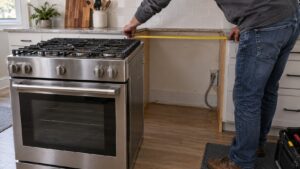

Freestanding KitchenAid ranges combine a cooktop and oven cavity in one appliance, so a single failed relay or igniter can knock out burners, the oven, or both at once. Our specialist technicians repair gas, electric, dual-fuel, and induction ranges, and we diagnose the shared control board and individual burner or element circuits separately to find exactly what stopped working.
Common KitchenAid range problems
Because a range handles both stovetop cooking and oven baking, failures tend to cluster around the components that bridge the two: the main control board, burner relays, and door latch assembly. Gas models develop weak or clicking igniters that won’t light a burner, electric and induction cooktops lose individual elements when a relay sticks, and dual-fuel units can show oven problems while the gas cooktop keeps running fine, or vice versa. Door latch problems that block self-clean, oven sensors that drift out of calibration, and keypads that stop registering touches round out the most common service calls.
- Burner igniter failure or clicking that won’t light a gas burner
- Stuck relay disabling one or more electric or induction cooktop elements
- Oven temperature sensor drift causing uneven baking results
- Door latch assembly problems blocking self-clean lock or release
- Control board communication errors between cooktop and oven functions
- Keypad failure or unresponsive touch controls
A thorough KitchenAid range repair visit checks both the cooktop and oven circuits even when only one side is symptomatic, since shared wiring can mask a second developing problem.
Our KitchenAid range repair process
Technicians begin by running the range’s built-in diagnostic mode and checking burner relays, igniters, and the oven sensor with a multimeter before opening anything up. Gas components are tested for both ignition timing and gas flow, while induction and electric elements are checked for relay continuity under load. Once the failed part is confirmed, you get a clear estimate starting from a stated from-$X figure, replacement parts are sourced from trusted parts suppliers, and the finished KitchenAid range repair is covered by our labor guarantee against repeat failure.
KitchenAid range models we service
We work on freestanding gas ranges, all-electric ranges, dual-fuel ranges pairing a gas cooktop with an electric convection oven, and induction ranges using electromagnetic cooktop elements. Many of these models include Even-Heat true convection in the oven cavity and a PrintShield finish on the exterior, and our technicians know to avoid abrasive cleaners or tools that could damage that fingerprint-resistant coating during a repair visit.
Error codes and diagnostics
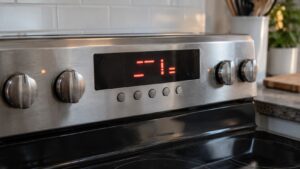
KitchenAid ranges use the same paired letter-number code format as wall ovens. F1 E0 is an EEPROM checksum failure and F1 E1 means the keypad’s calibration data was lost, while F2 E0 flags a shorted key and F2 E1 an open keypad circuit. F3 E0 and F3 E1 point to an oven sensor that’s open or shorted, F5 E1 signals a door latch switch failure, and F6 E0 marks a communication error between boards. F7 E1 means the bake element relay is stuck on, while F7 E5 and F7 E6 identify a stuck relay on the left-rear or right-rear burner respectively, a distinction that matters because it tells the technician exactly which relay to test first. F9 E0 warns of an oven temperature runaway, and PF simply logs a power interruption. Our error codes page breaks down each code with the affected components.
Service areas
We cover the metro area and outlying communities, with technicians dispatched on a next-available basis. See our locations page for confirmed service zones, and if you’re comparing models before a replacement decision, our models section outlines specifications across the current range lineup.
Schedule your KitchenAid range repair through our booking page, or check full specifications at KitchenAid.com beforehand.
We also see dual-fuel range calls where a homeowner assumes the whole unit has failed because the oven display is dead, when in fact only the electric convection side has lost power while the gas cooktop keeps working normally on its own separate ignition circuit. Confirming which subsystem is actually affected before troubleshooting saves considerable time, and it’s one of the first questions our technicians ask when a range service call comes in.