This overview covers Kitchenaid Cooktops — the lineup, signature technologies, common problems, and upkeep.
Understanding the Kitchenaid Cooktops
Below, our specialists break down everything you need to know about the Kitchenaid Cooktops.
The KitchenAid cooktop lineup
KitchenAid sells cooktops across three fundamentally different heating technologies: gas, electric radiant (glass-top with coil or ribbon elements underneath), and induction. The company’s Architect Series covers mainstream gas and radiant configurations in 30- and 36-inch widths, while the Pro Line induction cooktops target buyers who want the speed and precision that only a magnetic field can deliver. Within each family, KitchenAid varies burner count, output — including a high-output power burner on many gas models for rapid boiling — and control style, from mechanical knobs on entry gas cooktops to full capacitive touch interfaces on induction units.
Because these are three genuinely different technologies sharing one brand name, “a KitchenAid cooktop” can mean an open-flame gas surface, a resistive glass surface, or a magnetically-coupled surface with no visible heating element at all — worth knowing before you diagnose a problem or shop for a replacement.
Signature technology
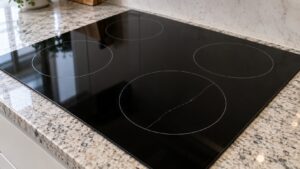
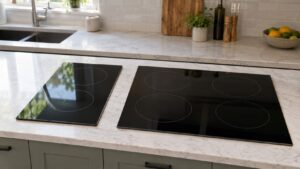
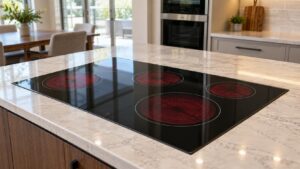
KitchenAid’s induction cooktops use electromagnetic coils beneath the glass surface to induce heat directly in ferrous cookware, which is why an induction zone will refuse to activate for aluminum, copper, or glass pans — the cooktop is detecting the absence of a magnetic load, not malfunctioning. This same technology is what makes induction cooktops able to boil water dramatically faster than gas or radiant elements and hold a precise simmer without cycling on and off. Gas models in the lineup typically include a dedicated power burner rated well above standard output for stockpots and woks, alongside simmer burners tuned for delicate sauces. Touch-control interfaces, standard on higher-tier induction and many radiant cooktops, replace mechanical knobs with capacitive sensing and often include a residual-heat indicator that stays lit until the glass surface has cooled to a safe temperature.
Common problems over time
Gas cooktops accumulate the most mechanical wear at the igniter and burner ports, since boil-overs and food debris are drawn directly into the ignition path every time the cooktop is used. Electric radiant elements degrade more slowly but eventually develop hot spots or fail relays that leave one zone under- or over-performing relative to its dial setting. Induction cooktops are the most electronically complex of the three, and their failure points tend to be the inverter board that drives each coil and the touch-control membrane itself, which can become unreliable after years of spills seeping around the glass edge. Across all three types, a cooling fan that runs long after the cooktop is off is normal on induction models — it’s protecting the electronics — but constant fan operation with the cooktop cold is usually a sign of a stuck thermal sensor.
Maintenance that extends cooktop life
Wiping gas burner caps and igniter tips after every use prevents the buildup that causes hard starts and no-ignition calls, and periodically removing burner grates for a full cleaning keeps ports clear. Glass-top radiant and induction surfaces should be cleaned only with a ceramic-glass-rated cleaner and a non-abrasive pad — grit dragged across the surface during cleaning is a common cause of scratches that are often mistaken for defects. For induction cooktops specifically, confirming your cookware is induction-compatible (a magnet sticks to the pan’s base) before assuming a heating zone has failed saves an unnecessary cooktop repair call. If you do run into a persistent error code, our error code library covers the F-series codes shared across the KitchenAid cooktop lineup, and KitchenAid’s own kitchenaid.com site has model-specific use-and-care documentation worth keeping on hand. When a repair is more involved than a cleaning, book a service visit and an independent technician will diagnose it on-site.
Choosing the right cooktop for your kitchen
Homeowners replacing an aging cooktop often ask whether to switch technologies entirely — moving from gas to induction, for instance, in kitchens being remodeled for better ventilation or faster cooking. Induction rewards a full set of magnetic cookware and a slightly higher upfront cost with lower ambient kitchen heat and easier cleanup, since nothing on the glass surface actually gets hot except from contact with the pan itself. Gas remains the choice for cooks who rely on visual flame control or use cookware that isn’t induction-compatible, and radiant electric splits the difference for kitchens without a gas line where induction’s higher price isn’t justified. Whichever technology is already installed, our technicians can usually keep it running well past the point most owners assume a full replacement is necessary.