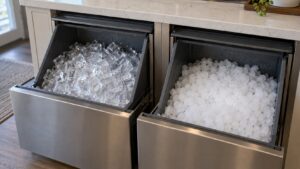
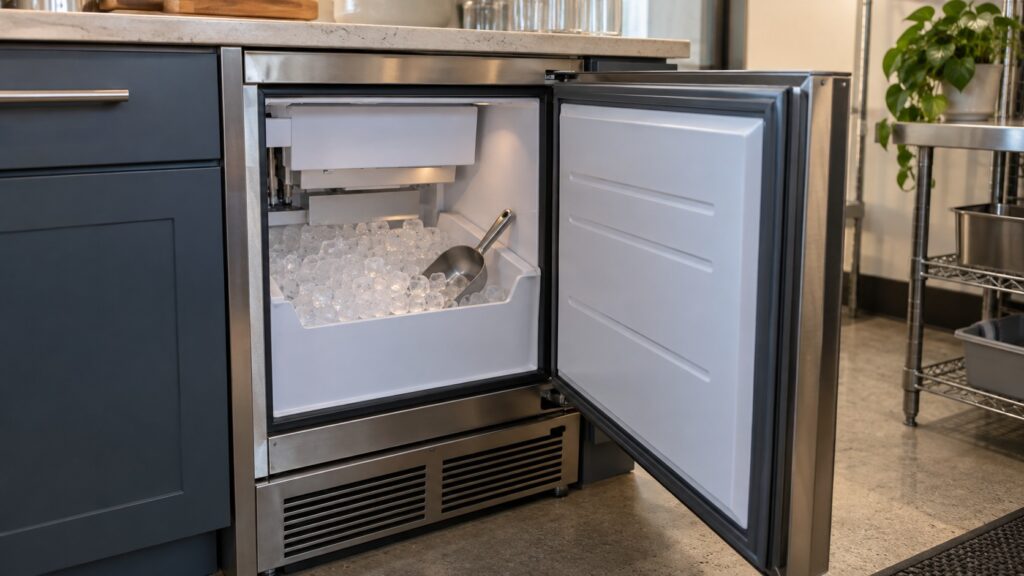
Good KitchenAid ice maker tips are mostly about production and timing rather than about the machine itself. An undercounter ice machine has a fixed output per day, and the households that run short are usually asking for a week’s ice in an afternoon. These tips cover how to get the most out of the machine you own, how to keep the ice tasting like nothing at all, and which habits quietly cost you capacity.
Understand the daily rate
These machines make ice steadily over a day, not on demand. That daily figure is measured under ideal conditions — a cool room, cold incoming water, a clean condenser — and a hot kitchen in August will produce less. Nothing is wrong with a machine that makes less ice in summer; it is doing more work for each cube.
The practical consequence is planning. If you entertain, start the bin filling a day or two ahead and move the surplus into freezer bags. A machine that has been emptied completely will take many hours to refill, and there is no setting anywhere on it that makes that go faster.
Keeping the ice tasting of nothing
Ice absorbs odors, and a bin sitting in a kitchen is exposed to all of them. Three habits fix nearly every “the ice tastes strange” complaint: keep the bin lid or door closed, do not store anything else in the bin, and empty the bin completely every few weeks so old ice does not sit and take on flavors.
The other half is the water. A filter on the supply improves taste noticeably in most municipal water, and it reduces the mineral load that becomes scale inside the machine. Change it on schedule — a filter left past its life is doing nothing at all while everyone in the house assumes it is quietly working, and the mineral load goes straight into the machine.
Airflow, the invisible capacity control
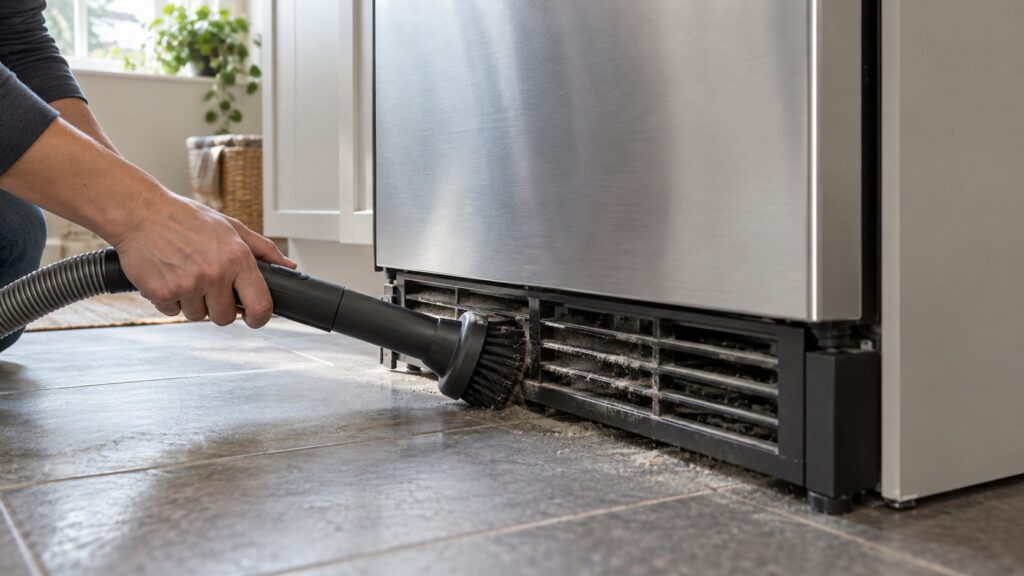
An undercounter machine breathes through its front grille. Anything in front of it — a trash can, a stack of trays, a cabinet panel fitted flush to the floor — reduces the airflow and lengthens every freeze cycle. That shows up as lower output rather than as a fault, which is why it goes unnoticed for months.
Vacuum the grille every few months, keep the area in front of it clear, and remember that the room’s temperature matters too. A machine in a hot bar area or beside an oven has a harder job than the same unit in a cool pantry, and its output will show it.
Two placement decisions are worth making deliberately when the kitchen is designed. Keep the machine away from the dishwasher and the oven if the layout allows, because both throw heat into the same cabinet run. And think about where people will actually reach for ice: a machine on the far side of an island from the drinks is a machine whose door is opened more often and for longer, and every opening is warm air landing on cold ice.
What the machine is telling you
Fused ice deserves its own note because it frightens people. Ice stored in an insulated bin slowly melts and refreezes into a block; that is what an ice machine does, and it is not a fault. Scoop it out, break it up, and use the machine more often — a bin whose ice turns over regularly never fuses in the first place.
Descaling is not optional
A clear-ice machine concentrates minerals inside itself on every cycle, which is exactly why the ice is clear. Descaling on the schedule in the manual is the single job that decides how long the machine lasts, and skipping it produces cloudy ice first and a slab that will not release later. Our guide on ice maker maintenance sets out the routine, and it is worth putting in a calendar rather than relying on memory.
Small habits worth building
Use the scoop and keep it outside the bin in a clean container, since a scoop left buried in the ice is both a hygiene issue and an obstruction. Do not force ice into the bin from bags of store-bought ice, which arrives wet and fuses into a block. And if the machine will be unused for a long period — a vacation home, a closed season — empty the bin, shut off the water and clean it before shutting it down, rather than leaving standing water inside.
If the machine will stand idle for a season — a vacation home, a bar that closes in winter — shut it down properly rather than simply switching it off. Close the water, empty the bin, wipe it dry and leave it open. Standing water in a closed, warm machine is how an ice maker develops a smell that takes weeks of cycles to clear, and it is the single most common complaint after a house has been empty.
When to call
Call when output falls with a clean grille and a recent descale, when cubes stay cloudy, when water appears around the cabinet, or when the machine runs constantly for little ice. Those are the four symptoms that separate a machine needing service from one that is simply being asked for more than it can make — and our guide on an ice maker that stops making ice covers the checks in order.
We are an independent repair company and not a factory service arm. Pricing starts from a diagnostic visit, and we confirm the estimate before any work begins. KitchenAid ice maker repair covers water valves, harvest systems, pumps, condensers and controls, and you can schedule a visit online.