The KitchenAid ice maker error codes run E1 through E5, and they are not a severity scale. E1 is a cooling or motor failure and stops production outright. E4 means the bin is full or has been taken out, which is the machine working exactly as designed. Between those two sit a damper that did not finish its cycle, a harvest heater that ran too long, and a bimetal that never let the batch release. Reading the number as “bigger is worse” is the single most common wrong turn on these machines.
What does E1 mean on a KitchenAid ice maker?
E1 is the code that actually stops the machine. It covers two conditions that look identical from outside: the unit is not getting cold, or the LPIM motor that drives the ice-making mechanism has failed. Either way no ice forms, and the display shows E1 rather than pretending to work.
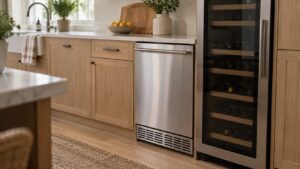
Start at the outside of the cabinet, because an undercounter ice machine is the appliance most often defeated by its own installation. The condenser sits behind the toe grille, it pulls warm room air through a very small area, and in a closed cabinet run it clogs with dust in a season. A machine that cannot dump heat cannot freeze water. Pull the grille, vacuum the coil, confirm the grille is not blocked by flooring or a kick panel added after the unit went in, and give it a day.
If the coil is clean and E1 returns, the fault is inside: the sealed system, the fan, or the motor itself. None of those are owner work.
What does E2 mean, and why is a damper involved?
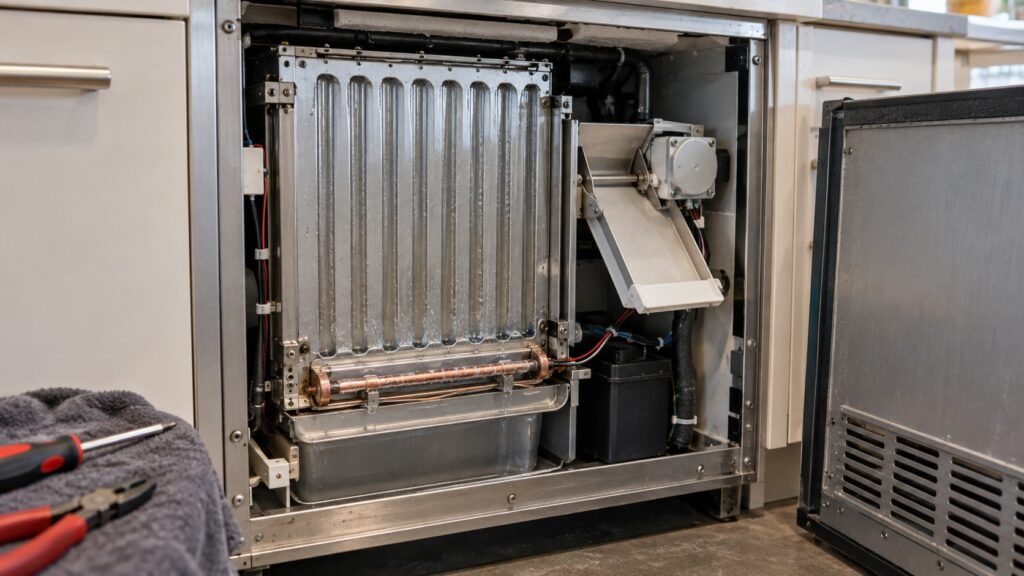
E2 says the damper cycle did not complete. The damper is a small motorized air door that opens and closes to control how much cold air reaches the freezing chamber during a batch. The control commands it to move, waits for the confirmation that it reached position, and posts E2 when that confirmation does not arrive in time.
Two things stop a damper. The first is ice: a machine running in a humid room, or one whose drain is slow, builds frost around the door until it binds. The second is the linkage or the motor itself. The difference is easy to feel. Switch the unit off at the control, let it sit with the door open for four to six hours until everything inside is above freezing, wipe it dry, and restart. A damper that was frozen works; a damper that has failed posts E2 again before the first batch finishes.
What do E3 and E5 have to do with the harvest heater?
Both of them. An undercounter ice machine does not push ice off the evaporator mechanically; it warms the surface just enough for the slab to let go. That warming is the harvest, and it is watched by a thermistor and limited by a bimetal.
E3 is the harvest running too long, or the thermistor reading outside its valid range. The control gives the heater a window, and if the temperature it expects never arrives, it stops rather than keep heating. E5 is the other side of the same mechanism: the batch did not release when it should have, so the control abandoned sensor-driven harvesting and fell back to a fixed timer, flagging the bimetal as the suspect.
What both codes mean in practice is that ice is forming but not leaving. You will often find a slab still stuck to the evaporator when you open the door. Scale is behind more of these than component failure, which is why the cleaning interval on these machines is not optional; our ice maker maintenance guide covers the descaling routine and how often a hard-water home needs it.
Why is E4 not a repair at all?
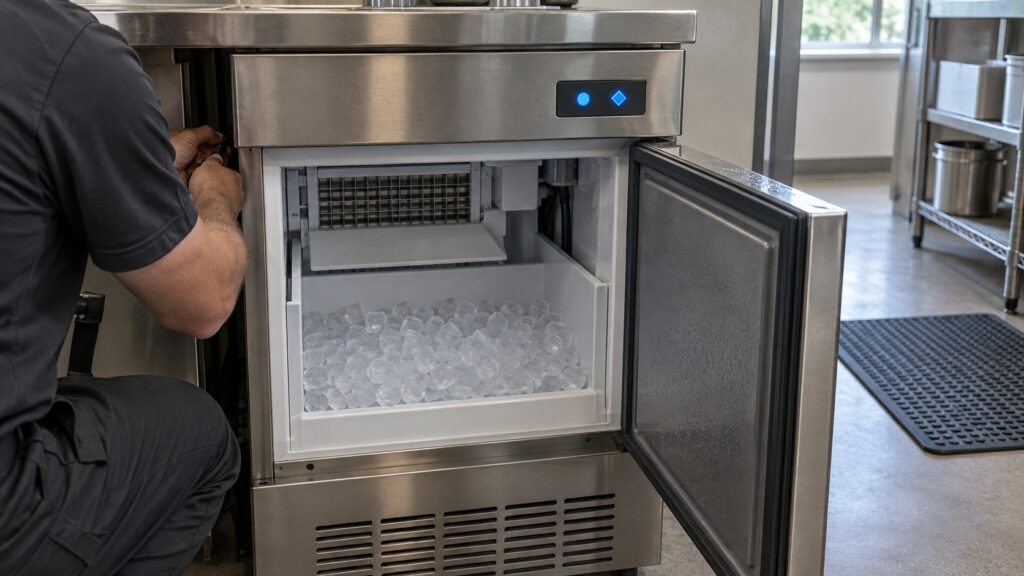
E4 reads “ice bin full, or bin not present,” and it is the code we are called about that needs no call. The machine has a sensor watching the bin. When the ice reaches it, production stops, which is the entire point of an automatic ice maker. When the bin has been pulled out to fill a cooler and pushed back crooked, the same sensor sees nothing there and stops for the same reason.
So the check is thirty seconds long. Pull the bin out, seat it fully, and look at the sensor window on the cabinet wall for frost, a splash of water, or a stray cube leaning against it. A bin that sits a half inch proud because a cube wedged behind it produces a machine that “died overnight” and is fine the moment the bin goes home.
What do CL and Er mean?
CL is a cleaning reminder. It counts hours, not faults, and it appears whether the machine is working perfectly or not. Run the cleaning cycle with the cleaner the manual specifies and reset it. Ignoring CL for a year is how an E3 or E5 gets made, because scale on the evaporator is exactly what stops a slab from releasing.
Er is different and it changes the order of everything else. Er means the control board and the interface have lost communication, so the numbers on the display are no longer a reliable report of what the machine is doing. Cut power at the breaker for two minutes and restart. If Er returns, chase Er first and treat any other code showing alongside it as unconfirmed.
Which of these can you clear yourself, and when do you call?
E4 and CL are yours, always. E2 is yours if a defrost clears it. E3 and E5 are yours as far as a full clean and descale go, and no further, because the next step is the harvest heater and the thermistor inside a live cold-side assembly. E1 and a repeating Er are service calls from the start.
Stop before removing the evaporator shroud, the heater or the drain pump. Those sit where mains wiring meets the water circuit, and an ice machine keeps standing water in the base long after it is switched off. If the machine makes no ice at all and shows no code, the causes are different again and our guide on a KitchenAid ice maker that is not making ice is the better starting point, while our ice maker tips cover output and taste once the codes are gone.
We are an independent repair company, not a factory service arm. Pricing starts from a diagnostic visit and we confirm the estimate before any work begins. KitchenAid ice maker repair covers the damper, the harvest heater, the thermistor and the sealed system, and you can schedule a visit online or call 1-844-755-8060 with the code on the display.