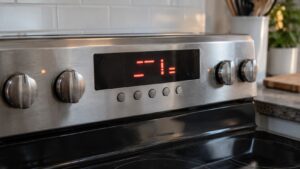
This guide explains the Kitchenaid Range F3 E0 Error: what it means, what causes it, and how to resolve it safely.
This guide explains the Kitchenaid F3 E0 Error 3: what it means, what causes it, and how to resolve it safely.
Understanding the Kitchenaid Range F3 E0 Error
Below, our specialists break down everything you need to know about the Kitchenaid Range F3 E0 Error.
Understanding the Kitchenaid F3 E0 Error 3
Below, our specialists break down everything you need to know about the Kitchenaid F3 E0 Error 3.
What F3 E0 means on your KitchenAid Range
A KitchenAid range that suddenly displays F3 E0 is reporting one specific condition: the control board reads an open circuit from the oven temperature sensor (RTD probe). Without a valid temperature signal, the board cannot regulate heat safely, so it shuts down the bake and broil elements and displays F3 E0. Stripped of the technical language, this is a case of oven sensor open circuit.
The good news about a KitchenAid F3 E0 error is that it rarely appears out of nowhere — it’s the end result of a specific, traceable failure that experienced technicians can usually pin down within a single visit. F3 E0 is caused by a hardware open circuit — resetting the control board will not restore the missing sensor signal. The problem will return immediately after every reset until the sensor or harness is repaired.
Symptoms
- The control panel displays the F3 E0 error code and refuses to clear with normal button presses.
- The code returns immediately after every power cycle because the problem is a hardware condition, not a software hiccup.
- Related symptoms can include the specific issue described by “Failed oven temperature sensor (RTD probe)” — the resistance-temperature detector mounted on the oven cavity wall has an open internal element, sending infinite resistance to the control board.
- Cooking or heating functions tied to this problem (oven sensor open circuit) are locked out until the code is resolved.
- In some cases you’ll also notice signs pointing toward “damaged control board sensor input circuit”.
Common causes
The following causes account for nearly every case of F3 E0 we see on KitchenAid ranges:
- Failed oven temperature sensor (RTD probe). The resistance-temperature detector mounted on the oven cavity wall has an open internal element, sending infinite resistance to the control board. This is sometimes something you can check yourself first.
- Broken or disconnected sensor wire harness. The two-wire harness connecting the sensor to the control board has broken, corroded, or pulled free from its connector, interrupting the circuit. This is sometimes something you can check yourself first.
- Damaged control board sensor input circuit. If the sensor and harness test correctly, the problem lies in the board’s sensor-reading circuitry — a component-level failure that requires board replacement. This typically requires a technician to resolve.
Troubleshooting steps you can try
Try the following in the order shown. They are safe for most range owners and help confirm whether the issue is a quick fix or needs a specialist.
- Check sensor resistance with a multimeter. With the range unplugged, locate the sensor probe on the upper-rear oven cavity wall, disconnect its two-wire harness, and measure resistance across the sensor terminals. A good sensor reads approximately 1,080–1,090 ohms at room temperature (68°F). An open-circuit reading (OL or infinite resistance) confirms the sensor has failed and needs replacement — it is typically a .
- Inspect the sensor wire harness for damage. Trace the two-wire harness from the sensor to the control board connector. Look for burned insulation, broken wires, or a connector that has pulled free from its lock tab. A broken wire near the connector is a common failure point on slide-in models where the harness flexes when the oven door opens repeatedly.
When to call a technician
Hand the range over to a qualified technician in these situations:
- Sensor resistance is within spec but the code persists — suggests a faulty control board
- Harness damage is located inside the oven cavity wall, requiring panel removal
Still seeing F3 E0 on your range? That points to a repair best left to a professional. Request a technician online, explore our error-code library, or visit kitchenaid.com for model information.