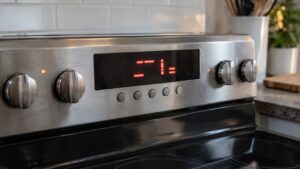
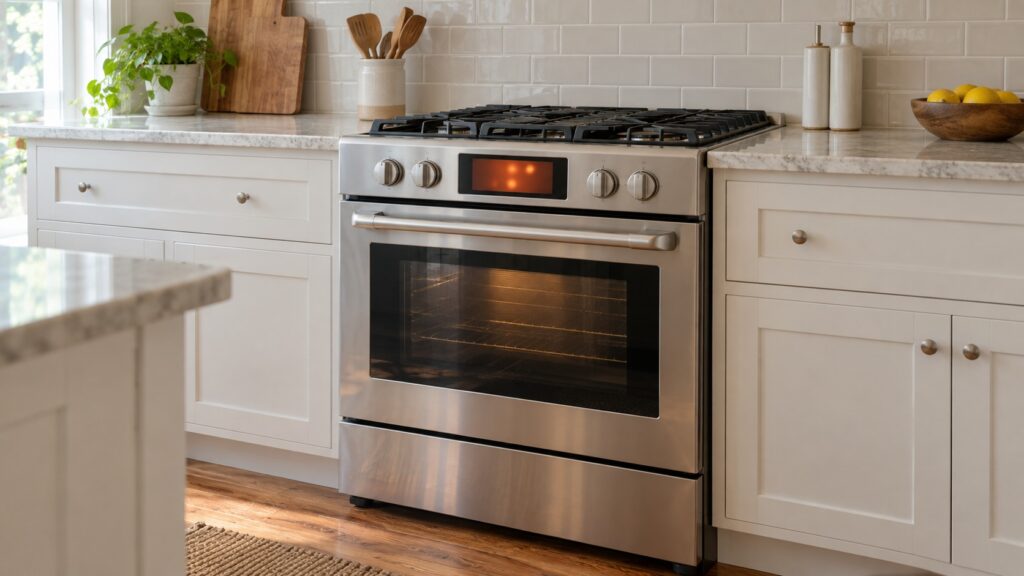
TL;DR: KitchenAid range F7 E1 means a relay for the bake element has stuck closed, so the control board cannot switch that circuit off even after it sends the signal to stop. The oven may keep heating past the set temperature, or the code may appear the moment you start a bake cycle. F7 is a family of relay codes, and the second pair of digits after the dash tells you which burner or element is the one stuck — E1 is always the bake element, never a surface burner.
What does F7 E1 mean on a KitchenAid range?
On a KitchenAid range with an electronic control board, every heating circuit — the bake element, the broil element and each surface burner — passes through its own relay before it reaches line power. The control board opens and closes these relays to start and stop each circuit. F7 E1 specifically means the relay assigned to the bake element failed a self-test: the board tried to open the circuit and the relay did not release, or the board detected voltage on that circuit when the relay should have been open. The bake element can keep drawing power even with the oven display showing “off,” which is why the range treats this as a safety fault rather than a cosmetic one.
The letter-number pattern matters more than it looks. F7 always names a stuck relay; the two digits after the dash name which one. That is why F7 E1, F7 E5 and F7 E6 look almost identical on the display but point at three different physical parts — one inside the oven cavity, two on the cooktop. Ordering a bake element relay when the real fault is the left rear burner relay wastes a part and does not clear the code.
Why does a stuck relay show up as F7 E1 instead of just failing quietly?
KitchenAid ranges run a relay self-check every time a heating cycle starts or ends, not only when a problem happens. This is a deliberate design decision: a relay that welds itself shut in the closed position is a fire risk, because the element keeps heating even when every indicator on the range says it should be off. The self-check exists specifically to catch that condition before the oven cavity overheats. When the check fails, the board locks out that heating circuit and displays F7 E1 rather than letting the range keep running with a heating element it cannot control.
Two things commonly trigger the fault. A relay contact can weld shut after years of switching a high-current load, which is ordinary wear rather than misuse. Or the control board itself can mis-read the relay state because of a failing sense circuit on the board, in which case the relay is fine and the board is not. Both produce the identical F7 E1 code, and only testing at the terminals tells you which one you actually have.
Is it safe to keep using the oven with an F7 E1 code showing?
No. If the display shows F7 E1, treat the bake element as potentially live even with the oven “off,” and do not run a bake cycle to see if the code clears itself. A relay that already failed one self-test is the least reliable moment to trust with an unattended cook. Turn off power to the range at the breaker rather than only at the control panel, since the control panel switch does not remove power from a relay that is stuck closed.
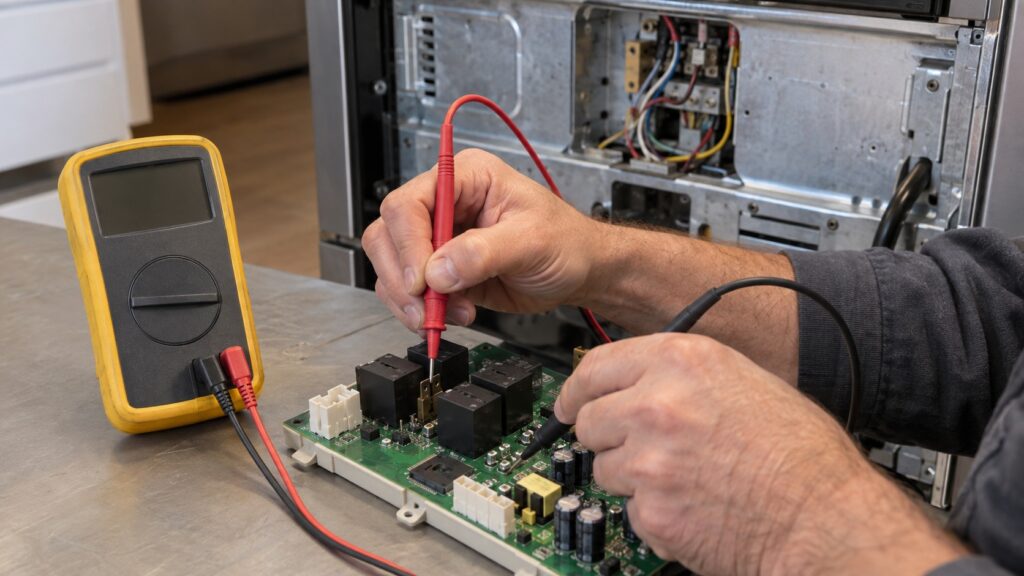
Do not open the rear control panel or the back of the range to look at the relay board yourself. The bake circuit runs at full line voltage, the relay board sits close to other live connections, and a welded relay does not always look different from a healthy one without testing under load. This is diagnostic and repair work for someone with a meter and the range’s wiring diagram, not a visual inspection.
How is an F7 E1 range diagnosed correctly?
A technician isolates F7 E1 by testing the bake relay and its board traces with power removed, then confirming which side of the fault is bad before ordering anything. The usual sequence: verify the relay contacts are actually welded (rather than the board mis-reporting), check the control board’s relay-drive circuit for the bake channel, and inspect the wiring harness between the board and the element for a short that could mimic a stuck relay. Because F7 E5 and F7 E6 use separate relays on the same board, a tech will often check the whole relay bank at once rather than pulling the board apart twice for two separate visits.
Replacement is almost always the control board itself on ranges where the relays are soldered onto the main board rather than socketed separately — very few current KitchenAid boards use a swappable relay module. That is also why an accurate diagnosis before ordering parts matters: a control board is one of the more expensive parts on the range, and confirming the fault first avoids paying for a board that was never the problem.
What should you check yourself before calling for service?
- Cut power at the breaker for a full two minutes, then restore it. Some relay faults are a stuck-condition report that clears on its own restart; if F7 E1 returns immediately, the relay is genuinely stuck.
- Note whether the oven was mid-cycle or idle when the code appeared. A fault that shows only during preheat points more toward a thermal or sensor issue feeding into the relay logic; one that shows the moment power is restored points more toward the relay itself.
- Do not reset the code repeatedly by cycling breaker power over and over. Each reset gives the relay another chance to weld shut under load, and repeated resets can turn a marginal contact into a fully failed one.
Beyond checking the breaker cycle and writing down when the code appears, there is nothing else safe to check without opening the range.
When does F7 E1 mean it is time to consider a new range instead of a repair?
A single F7 E1 event on a range that is a few years old is usually worth repairing — a relay or board swap restores full function. The calculation changes if F7 E1 is the second or third control-board-related code the same range has thrown, or if the range is already past the age where typical range repair costs start approaching a meaningful share of replacement cost. A control board failure on an older range is a reasonable point to weigh both options rather than defaulting to repair.
If your KitchenAid range is showing F7 E1, F7 E5 or F7 E6, our KitchenAid range repair technicians test the relay bank and the board before ordering a part, and we are an independent repair company, not a factory service arm, so the estimate reflects only what your range actually needs. You can read the full F7 E1 error code page for the specific fault description, or see how this fault compares with a runaway-temperature code in our guide to range burner or oven not working. Ready to get it looked at? Schedule a visit and have the exact code on hand when the technician arrives.