This guide explains the Kitchenaid Dishwasher F9 E1 Error: what it means, what causes it, and how to resolve it safely.
Understanding the Kitchenaid Dishwasher F9 E1 Error
Below, our specialists break down everything you need to know about the Kitchenaid Dishwasher F9 E1 Error.
Understanding the Kitchenaid F9 E1 Error
Below, our specialists break down everything you need to know about the Kitchenaid F9 E1 Error.
What F9 E1 means on your KitchenAid dishwasher
When the alphanumeric display on a KitchenAid dishwasher flashes F9 E1, the wash cycle has stalled partway through the drain phase. The control module tells the drain pump to push water out of the tub, then watches the water-level sensor to confirm the tub actually emptied inside a fixed window of time. If the level hasn’t dropped far enough by the time that window closes, the board halts the cycle and posts the code rather than letting the machine sit there running a pump against a blockage. In plain terms, a KitchenAid F9 E1 error is the appliance reporting that it tried to drain and failed to finish the job on schedule.
It’s worth separating this from a total pump failure, because the two look almost identical from the outside but have very different fixes. Sometimes the pump itself is fine and simply can’t move water fast enough because something downstream is choking the flow — a clogged filter, a pinched hose, a leftover knockout plug in a disposal. Other times the pump has genuinely lost pumping power because of a jammed impeller or worn motor windings. Distinguishing between the two is exactly what the checks below are designed to do before anyone reaches for a wrench.
Symptoms
- Standing water pooled in the bottom of the tub after a cycle ends
- F9 E1 displayed on the control panel, sometimes accompanied by a beep sequence
- A humming or straining noise from underneath the tub during the drain portion of the cycle
- Dishes that were mid-cycle come out wet with cloudy residue because the rinse never properly cleared
- The dishwasher appears to run normally through wash and rinse but stops abruptly near the end
Common causes
- Food debris has packed the cylindrical filter and mesh screen so tightly that the pump can’t draw enough water through to finish draining in time.
- The drain hose running to the sink or disposal has a kink, an internal blockage, or lacks the required high-loop, which lets sink water siphon backward into the tub.
- A hard object such as a piece of glass or a small bone fragment has lodged in the pump inlet or impeller, physically restricting its ability to spin.
- The pump motor itself has partially burned out internally, cutting its pumping power below what’s needed to clear the water in time.
Troubleshooting steps you can try
- Before touching anything inside the tub, it’s good practice to power the unit down at the breaker or unplug it if it’s on a cord — this avoids any chance of the pump cycling on while your hands are near it.
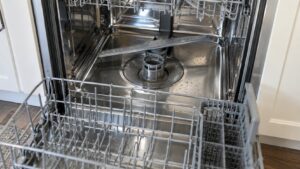
- Pull out the lower rack and remove both the cylindrical filter and the flat mesh screen beneath it. Rinse each one under running water until every trace of food residue is gone.
- With the filters out, shine a flashlight down into the sump well and look for anything unusual sitting near the pump inlet — small glass shards, fruit pits, and bone chips are common culprits that are easy to miss at a glance.
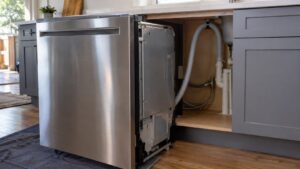
- Open the cabinet under the sink and trace the drain hose from the dishwasher to its connection point. Check for any place it’s been crimped, twisted, or pinched, and confirm it rises into a high loop before connecting to the drain.
- If the dishwasher drains into a garbage disposal, verify that the plastic knockout plug inside the disposal’s inlet port has actually been removed — this is an extremely common oversight after a new disposal is installed and will block drainage completely on its own.
- Restore power, run a short cycle, and watch whether the tub empties normally this time before assuming the pump itself is damaged.
When to call a technician
Certain dishwasher conditions are not safe or practical to fix yourself — call a professional if:
Persistent F9 E1 problems on a dishwasher are best handled by a specialist with the right parts. Book online, browse the error-code database, or see kitchenaid.com.