TL;DR: AquaSense is a cycle option on certain KitchenAid dishwasher models, and a poor result on that cycle specifically points at one of three things: clogged spray arms, a failed diverter, or a heating element that no longer reaches wash temperature. Knowing which of the three is behind a bad AquaSense cycle — rather than treating “AquaSense doesn’t work” as one vague complaint — is what turns a service call into a booked part instead of a guess.
What does AquaSense mean on a KitchenAid dishwasher?
AquaSense names a cycle option built into the control panel of certain KitchenAid dishwasher models — it is a program you select, not a physical part or a standalone sensor bolted onto the machine. Because it is a cycle rather than a component, AquaSense itself cannot fail in the way a pump or a heating element fails. What can happen is that the cycle runs and the result is disappointing: dishes come out spotted, cloudy or still soiled after a full AquaSense run. When that happens, the fault is never in the cycle selection logic — it is in one of the physical systems that every cycle, including AquaSense, depends on to actually clean and dry the load.
Understanding what AquaSense on a KitchenAid dishwasher actually is — a cycle, not a part — matters for anyone troubleshooting the machine, because it changes where you look. There is no “AquaSense module” to test or replace. There is a spray arm system, a diverter valve and a heating element, and AquaSense is simply the cycle that exposes their condition most clearly.
Why does a poor AquaSense result usually mean one of three specific things?
A dishwasher cycle can only fail in a handful of physical ways, and AquaSense’s particular combination of settings tends to surface exactly three of them. First, the spray arms need clear jets to distribute water evenly across every rack position; a clog anywhere on the arm reduces coverage to the dishes downstream of that clog, and the pattern of soil left behind often mirrors the exact spray pattern that was missing. Second, the diverter valve controls which spray arm — upper or lower — gets water at any given moment in the cycle; when it sticks in one position, one rack gets flooded with water while the other barely gets any, producing clean dishes on one level and soiled ones on the other. Third, even with perfect water coverage, a heating element that no longer reaches the cycle’s target temperature leaves grease and film that only heat, not water pressure, can release.
Checking these three in order — spray arms first, diverter second, heating element third — matches how easy each one is to rule out. A clogged spray arm is visible and can often be cleared without tools. A stuck diverter usually shows up as an obvious side-to-side or top-to-bottom split in cleaning results. A heating problem is the least visible of the three and typically the last one confirmed, often with a simple check of whether the tub feels appropriately hot partway through the cycle.
How is AquaSense different from ProWash on a KitchenAid dishwasher?
ProWash and AquaSense are both named cycles, and it is easy to assume they are variations on the same feature, but they solve different problems. ProWash is a sensing cycle: soil sensors read how dirty the incoming water is during the wash and adjust the wash time, temperature and number of passes automatically, so the machine tailors itself to how soiled the load actually is. AquaSense does not sense soil level and adjust itself the same way — it is a fixed cycle option, and its performance depends entirely on the spray arms, diverter and heater being in good working order rather than on any sensing feedback loop. In short: ProWash adapts to the dish load, AquaSense does not, which is exactly why a mechanical problem shows up more clearly on AquaSense than on a sensing cycle that might otherwise compensate for it.
What can you check yourself before assuming AquaSense is broken?
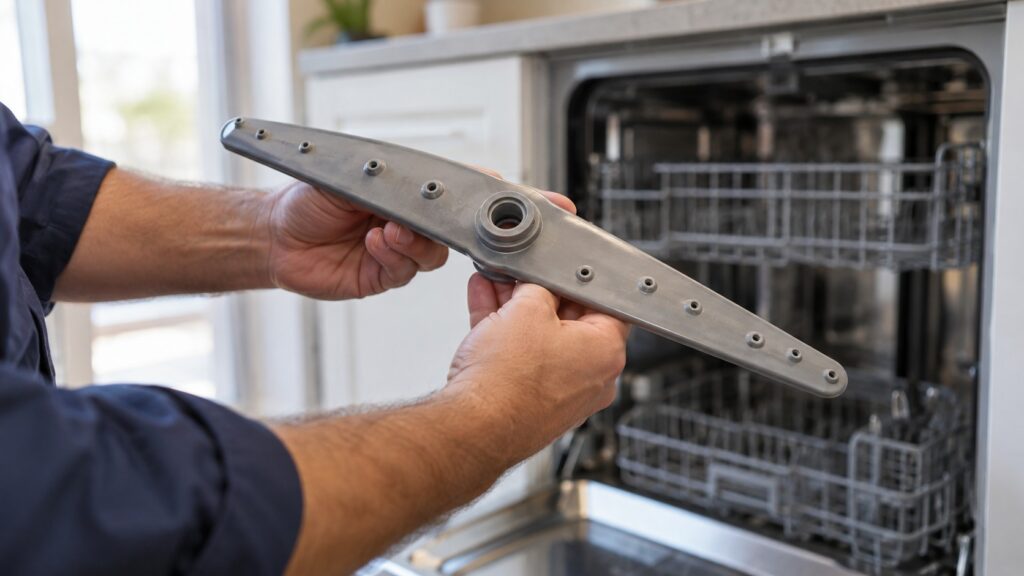
- Pull and inspect the spray arms. Most KitchenAid dishwasher spray arms lift out without tools. Hold each arm up to a light and look for jets with debris lodged in them, and rinse the arm under a faucet to confirm water passes freely through every hole.
- Run a short test cycle and listen for the diverter. A healthy diverter makes a faint, brief click or hum partway through the fill as it switches between spray levels. A diverter that never switches, or that grinds, is worth flagging before ordering a part.
- Feel the tub temperature partway through the main wash. It should feel distinctly hot to the touch by the middle of the cycle. A tub that stays lukewarm through most of the cycle points toward the heating element or its control circuit rather than the spray system.
None of these checks require opening the dishwasher’s cabinet or disconnecting anything electrical — they use only what is already accessible from inside the tub.
When is a poor AquaSense result worth booking a technician for?
If clearing the spray arms and confirming the diverter and heat all check out and the AquaSense cycle still leaves dishes spotted or under-cleaned, the fault is likely deeper than a simple clog — a diverter valve motor that is failing intermittently, or a heating element whose resistance has drifted, are both common at that point and both require testing with the panels removed. This is also the point where continuing to run cycles hoping for a better result stops being useful; a dishwasher that consistently underperforms on one cycle rarely self-corrects, and repeated cycles on hard water without proper heat can accelerate scale buildup on the same parts already struggling.
For the fuller list of KitchenAid dishwasher terminology beyond AquaSense — ProWash, ProDry, the third rack and PrintShield finishes among them — see our KitchenAid dishwasher terms glossary. If your dishwasher is leaving dishes wet as well as soiled, our guide to dishwasher not drying covers the drying side of the same machine. Our technicians diagnose spray arm, diverter and heating faults on KitchenAid dishwasher repair visits and confirm which of the three is at fault before recommending a part. Schedule a visit if clearing the spray arms did not fix your results.