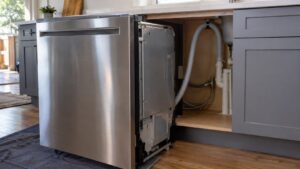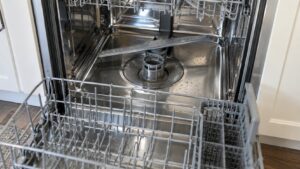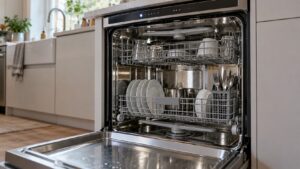
This guide explains the Kitchenaid Dishwasher F6 E1 Error: what it means, what causes it, and how to resolve it safely.
Understanding the Kitchenaid Dishwasher F6 E1 Error
Below, our specialists break down everything you need to know about the Kitchenaid Dishwasher F6 E1 Error.
Understanding the Kitchenaid F6 E1 Error
Below, our specialists break down everything you need to know about the Kitchenaid F6 E1 Error.
What F6 E1 means on your KitchenAid dishwasher
Newer KitchenAid dishwashers with alphanumeric displays use letter-and-number codes instead of blink patterns, and F6 E1 is the version of a no-fill problem on these models. The control board sends the command to open the inlet valve, waits for confirmation that water is actually flowing into the tub, and if that confirmation never arrives within the allowed window, it stops the cycle and shows this code rather than running dry. It’s the display-panel counterpart to the blink-code problem that older KitchenAid models throw for the identical underlying problem.
Most cases of the KitchenAid F6 E1 error trace back to something outside the dishwasher entirely — a supply valve that’s closed or restricted, or low incoming water pressure — before ever pointing to a failed part inside the machine. That makes this one of the more homeowner-friendly codes to start investigating, since the first checks require no tools and no disassembly at all.
Symptoms
- Dishwasher starts, runs briefly, and stops without any water sound entering the tub
- Display shows F6 E1 within the first minute or so of a cycle
- A faint click is audible from the inlet valve but no water actually flows
- Problem occurs on every attempt rather than intermittently
Common causes
- The shutoff valve under the sink feeding the dishwasher is partially or fully closed, blocking flow no matter what the inlet valve solenoid does
- Sediment inside the mesh screen of the water inlet valve has nearly blocked flow, dropping the fill rate below what the control board can detect
- The solenoid coil that mechanically opens the inlet valve has burned out and can no longer open the valve even when it receives the fill command
Troubleshooting steps you can try
- Open the cabinet under the sink and find the hot-water shutoff valve connected to the dishwasher’s supply line; turn it fully counterclockwise to make sure it’s completely open.
- If the valve was already fully open, close it, wait about ten seconds, and reopen it all the way — this brief flush can dislodge loose debris sitting right at the valve seat.
- While you’re under there, check the braided supply line for kinks near the valve connection and straighten any bends you find, since a kinked line can restrict flow enough on its own to trigger this problem.
- Reset the dishwasher by holding Cancel for about three seconds, or by switching the circuit breaker off and back on, then start a Normal cycle and listen for the sound of water entering the tub within roughly the first 30 seconds.
- Pay attention to whether you hear a valve click with no water following it — that combination points toward a valve or screen problem rather than a supply issue, and is worth mentioning if you end up booking a repair.
When to call a technician
Certain dishwasher conditions are not safe or practical to fix yourself — call a professional if:
When the F6 E1 error persists after these steps, an experienced technician should take over. You can schedule service in minutes, review other dishwasher error codes, or check specs at kitchenaid.com.