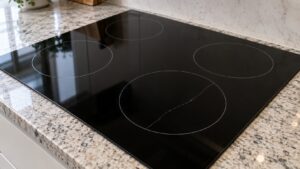
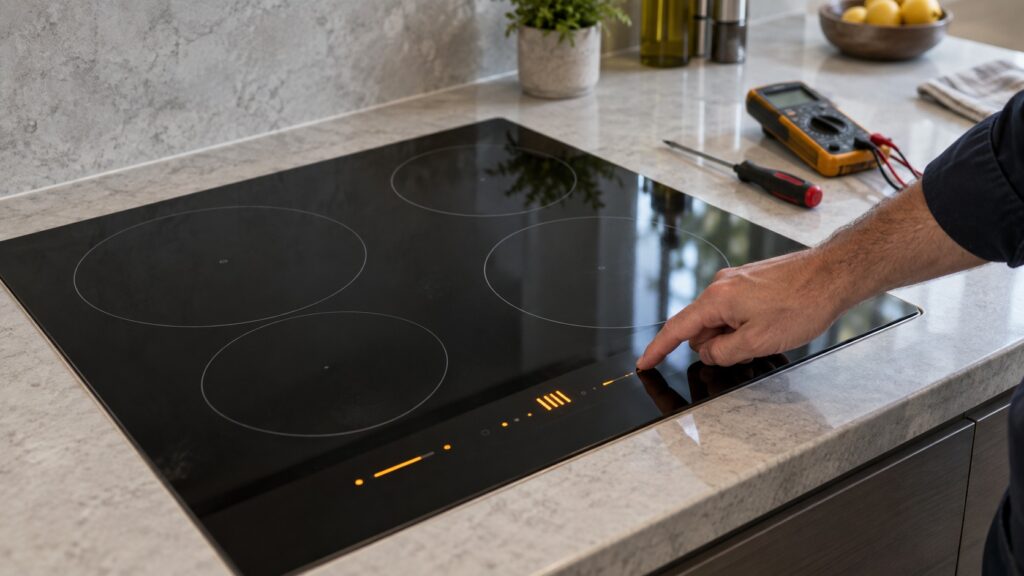
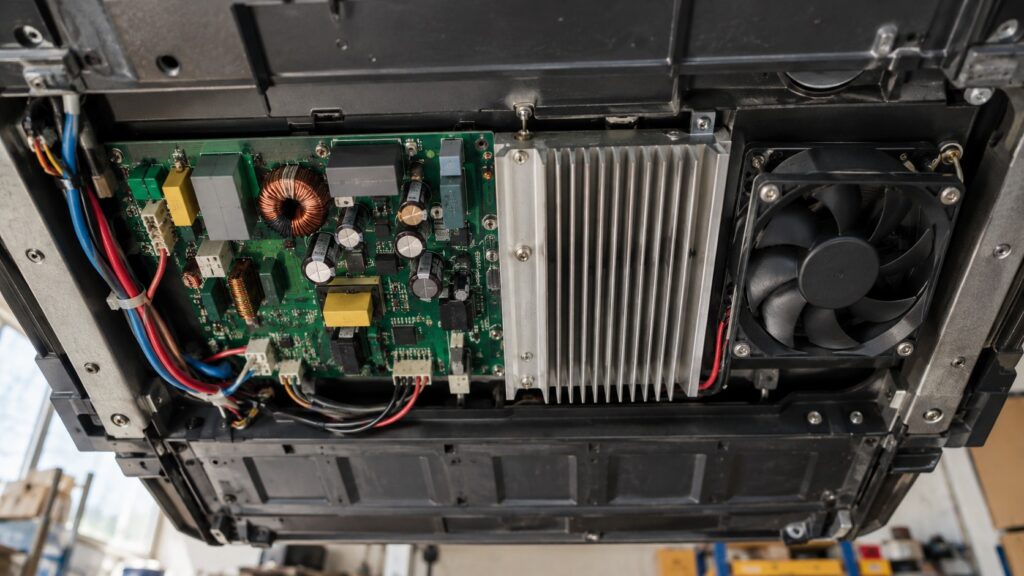
The KitchenAid kicu569xbl is a 36-inch induction cooktop with dual and bridge element zones, and its close relative the KICU509XBL is the 30-inch four-element Architect Series II version. Both use the same fault language, and it is not the language of a gas surface. An induction top has a power inverter under every zone, a fan to keep that inverter cool, and a sensor under the glass for each element, so its codes describe electronics and airflow rather than a flame that will not light.
What does E1 mean on a KICU569XBL induction cooktop?
E1 is an induction inverter overload. Each zone has its own inverter, a power stage that converts line voltage into the high-frequency field that heats the pan. When that stage draws more current than it is rated for, it protects itself and drops the zone, and the panel shows E1.
Overload has three ordinary causes and one serious one. A pan with a heavy ferrous base far larger than the zone, a warped base that rocks and couples unevenly, or an empty pan run at full power all push the inverter hard. The serious cause is heat: an inverter that is already running warm because airflow is restricted will overload at a load it would carry happily when cool, which is why E1 and F9 E0 so often appear in the same week.
Switch the zone off, let the top sit for fifteen minutes, and try a different pan at a lower setting. E1 on one zone with a known-good pan, repeatedly, is a service call. E1 that moves from zone to zone with the pan is the pan.
Why does F5 E0 appear when the pan looks fine?
Because “looks fine” and “detectable” are different tests. An induction zone confirms cookware by sensing the magnetic load, and three things defeat it. Cookware that is not ferrous enough, which includes most aluminum, copper and some stainless alloys. Cookware whose base is smaller than the minimum diameter the zone expects, which on a 36-inch top with bridge and dual zones varies from element to element. And cookware with a base that has bowed, so only a ring of it touches the glass.
A magnet is the field test: if it does not hold firmly to the underside of the pan, the KICU569XBL will not heat it. Our guide on how induction cooktops work covers the physics behind that, and the comparison of cooktop types is the place to start if you are deciding whether induction fits the way you cook.
What do F9 E0 and F3 E2 say about airflow?
They are the two ends of one problem. F9 E0 is a cooling fan failure and F3 E2 is a surface temperature that has gone past its limit, and on an induction top these are almost always about the same restricted air path.
The fan under an induction cooktop pulls air through a vent and pushes it across the inverters. Built-in installations defeat it constantly: a drawer cabinet packed to the top, a false panel added under the top after installation, insulation stuffed into the cavity during a remodel, or simply years of dust on the intake. The cooktop cannot tell the difference between a failed fan and a fan that is running against a blocked path, so both arrive as F9 E0.
F3 E2 says the glass has become too hot. Sometimes that is real cooking with an empty pan at maximum; more often it is heat that has nowhere to go. Clear the cabinet below, confirm the vent openings the installation called for are still open, and see whether the code returns. Our cooktop maintenance guide covers the intake cleaning that keeps this from becoming annual.
When is the control board the problem rather than a zone?
Four codes point at electronics rather than at anything you did. F1 E0 is an EEPROM failure, meaning the board cannot read its own stored settings, and nothing on the surface will behave predictably while it is showing. F6 E0 is a loss of communication between the user interface and the power board, so touches stop registering or registering wrongly. F7 E0 is a relay that has stuck, which is the one code on this list that can leave a zone powered when the display says it is off. F3 E0 is a sensor gone open circuit under one specific element.
F7 E0 deserves its own sentence. A stuck relay is a safety condition, not an inconvenience. If a zone stays warm after the cooktop says everything is off, switch the circuit off at the breaker and leave it off until the top has been looked at.
What can you check before calling, and what about L?
L is child lock active, and it is the most common false alarm on these tops. A cloth dragged across the panel while wiping holds the lock pad long enough to arm it, and the cooktop then refuses every touch. Press and hold the lock pad for the few seconds the panel indicates and the L clears.
- Power cycle at the breaker. Two minutes off clears a latched code that is no longer describing a live condition.
- Dry the panel completely. Moisture under the glass edge produces F2 E0, a stuck key that nobody is pressing.
- Swap the pan. This separates E1 and F5 E0 from anything electrical in about a minute.
- Open the cabinet below. Empty it, look for the vent path, and run the top again.
- Note which zone. On a 36-inch KICU569XBL with dual and bridge zones, “the left rear” is half the diagnosis.
Stop before lifting the glass. The inverters sit directly beneath it on live mains wiring, the top is bonded into the countertop cutout, and induction glass that has been stressed at one corner cracks without warning.
We are an independent repair company, not a factory service arm. Pricing starts from a diagnostic visit and we confirm the estimate before any work begins. KitchenAid cooktop repair covers inverters, sensors, relays and cooling fans on both the KICU569XBL and the KICU509XBL, and you can schedule a visit online or call 1-844-755-8060 with the code and the zone.