

The KitchenAid gas vs electric dryer question is settled by the laundry room far more often than by the appliance. Both dry clothes the same way — tumbling them through heated air and venting the moisture outside — and the difference is how that air gets heated, what the room has to supply, and what it costs to run once it is in. This guide covers the practical differences, including the ones that only show up years later.
What the room has to provide
An electric dryer needs a dedicated high-voltage circuit with the correct receptacle. If that circuit already exists, installation is a matter of plugging in, connecting the vent and leveling the machine. If it does not, adding one means an electrician and a run back to the panel — straightforward in an unfinished basement, expensive in a finished second-floor laundry.
A gas dryer needs a gas supply with a shutoff at the appliance, plus an ordinary outlet for the controls and the motor. Adding a gas line to a room that has none is a plumber’s job, and running one into an upstairs laundry is rarely trivial. Both machines need venting, and both are miserable without it.
Running costs, honestly
In most of the country gas is cheaper per unit of heat than electricity, so a gas dryer usually costs less per load. How much less depends entirely on local rates, and in areas with cheap electricity or expensive gas the gap narrows or reverses. It is worth looking at your own utility bill and doing the arithmetic for your own household rather than trusting a rule of thumb from a brochure.
What rarely changes is the purchase price gap — gas models generally cost a little more up front — and the maintenance picture, which is essentially identical. Both have a drum, a motor, a blower, a belt and a thermostat; the only real difference is a burner and igniter on one and a heating element on the other.
What actually determines drying time
That first row matters more than the fuel choice. A dryer of either type with a clean, short, rigid vent will outperform a better machine with a crushed flexible duct behind it, every time — and it is the difference our guide on a dryer that will not dry spends most of its time on.
Venting applies to both
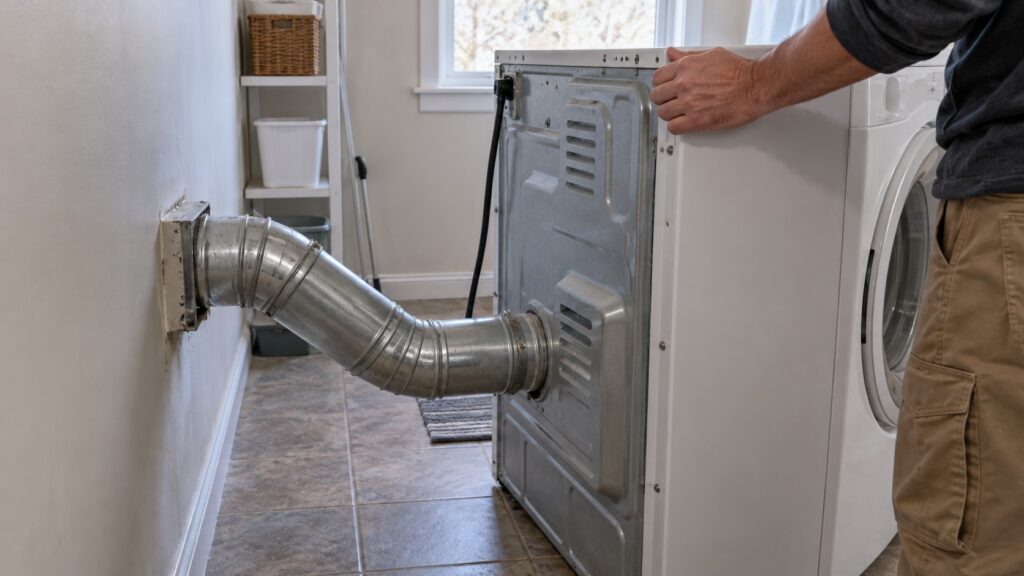
Use rigid metal duct with a smooth interior, keep the run as short and straight as the building allows, and fit a proper exterior hood with a working damper. Flexible foil duct collects lint, kinks behind the machine, and is a genuine fire risk. Never vent a dryer of any kind into an attic, a crawl space or the room itself.
Clean the duct annually and the lint screen every load. The requirements are the same whichever fuel you choose, and they are covered in our guide on dryer installation.
Two practical notes on the machines themselves. Gas dryers tend to reach temperature faster at the start of a cycle, which occasionally shows up as slightly shorter times on small loads, though modern moisture sensing evens most of that out. And electric dryers are quieter by a small margin, because there is no burner cycling on and off — noticeable in an open-plan home where the laundry is off the kitchen rather than in a basement.
Safety notes worth stating plainly
A gas dryer burns fuel, so it must be installed by someone qualified, with the correct connector and a leak check. It also has to be converted properly if the house is on propane rather than natural gas — that is a parts change, not a setting.
An electric dryer draws a large current. Its circuit, receptacle and cord must match, and a cord that has been swapped to fit an old outlet is a common and dangerous shortcut. Neither machine belongs on an extension cord, and neither should be run when nobody is home if the duct has not been cleaned in years.
Choosing in a sentence
Buy the fuel the laundry room already has, unless you are building or renovating and can choose freely — in which case gas usually wins on running cost where gas is cheap, and electric wins on simplicity and on future-proofing in an all-electric home. If neither service exists and you cannot add one, a ventless heat-pump dryer is the appliance that solves that problem, and our guide on repair or replace is the right place to start if the existing machine is the reason you are reading this.
One more thing to check before delivery day: the receptacle and the shutoff. An electric dryer needs the right receptacle for its cord, and the two common types are not interchangeable — changing a cord to fit an old outlet is a shortcut that turns up in insurance investigations. A gas dryer needs a shutoff at the appliance that someone can actually reach. Both are five-minute checks now and expensive rescheduling on the day.
When to call
Call when a dryer takes longer than it used to, when it stops heating, when it runs hot enough to worry you, when you smell gas at any time, or when you want the duct assessed before buying a new machine. A vent problem will disappoint you with any appliance, and finding it first is cheaper than discovering it after delivery.
We are an independent repair company and not a factory service arm. Pricing starts from a diagnostic visit, and we confirm the estimate before any work begins. KitchenAid dryer repair covers igniters, elements, thermostats, blowers, belts and controls, and you can schedule a visit online.