This guide covers Kitchenaid Wall Oven Installation & with practical, technician-backed advice.
A KitchenAid wall oven installation depends on the cabinet cutout matching your specific model’s dimensions, a 240V circuit rated for the oven’s draw, and — for double wall ovens — enough structural support in the surrounding cabinetry, all of which is why wall oven swaps are rarely a simple drop-in even when replacing the same brand.
Understanding the Kitchenaid Wall Oven Installation &
Below, our specialists break down everything you need to know about the Kitchenaid Wall Oven Installation &.
Cutout Size Is Not Universal
Unlike a range, a wall oven sits inside a built cabinet opening, and cutout dimensions vary not just between brands but between KitchenAid models and single versus double oven configurations. Replacing an older wall oven with a newer KitchenAid model can require cabinet modification even if the exterior appliance size looks similar, because trim kits, venting, and depth requirements have changed across product generations. Always confirm cutout dimensions against your specific model’s installation manual before ordering.
Electrical Requirements
Wall ovens need a dedicated 240V circuit, and the amperage requirement increases for double oven models since two cavities draw more power than one, especially when both are running self-clean or convection at once. If your kitchen’s wall oven circuit dates back to a smaller single-oven install, upgrading to a double oven may require running new wiring — a detail worth checking during the quote stage rather than on installation day.
Single vs. Double Oven Considerations
Double wall ovens are significantly heavier than single units and require secure mounting brackets and adequate cabinet support, since an improperly anchored double oven is a tip and injury hazard. If you’re deciding between a single oven with a separate cooktop versus a double wall oven setup, weigh your household’s cooking volume against the cabinet space and electrical capacity you have available. For cooktop pairing details, see our cooktop installation guide.
Ventilation and Clearance
Wall ovens vent through the front, so unlike a range they don’t need a dedicated exhaust hood, but they do need adequate clearance around the unit for heat dissipation as specified in the installation manual. Cabinets built too tightly around the oven can trap heat and shorten the life of electronic control boards.
What Drives Installation Cost
Cost factors include whether the existing cutout fits the new oven without modification, whether new electrical wiring is needed, whether the old unit needs removal and disposal, and whether trim kits are required to bridge a size difference between the old and new appliance. A technician who inspects your cabinet opening in person can give a far more accurate quote than an estimate based on model number alone.
Why This Job Calls for a Specialist
Wall ovens are heavy, require precise leveling within a fixed cabinet space, and involve a 240V connection — a combination that makes professional installation the safer and generally faster route compared to DIY. Our experienced technicians handle the cutout verification, electrical connection, and secure mounting so the oven is ready to use safely from day one. For current KitchenAid wall oven dimensions and specifications, visit KitchenAid’s official site.
Timeline Expectations
A straightforward wall oven swap into an existing, correctly sized cutout with compatible wiring can typically be completed in a few hours. Jobs requiring cabinet modification, new wiring, or trim kit sourcing take longer and may need to be scheduled in two visits — one to assess and order any needed parts, and a second to complete the install once everything is on hand.
Combination Microwave-Oven Units
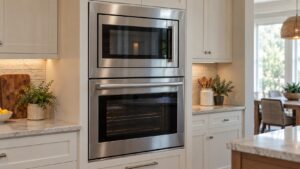
Some KitchenAid wall oven cabinets house a combination microwave and oven unit stacked together, which adds an additional cutout and electrical connection to plan for. If you’re replacing a standalone wall oven with a combination unit, or vice versa, expect a larger cabinet modification than a straightforward oven-for-oven swap.