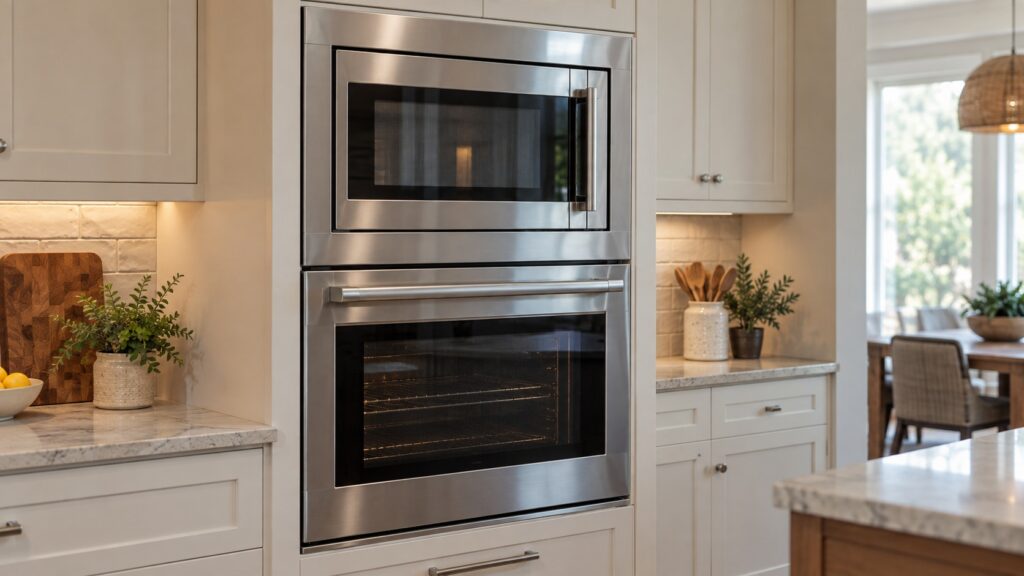
The KitchenAid koce500ess is a 30-inch combination wall oven: a microwave in the upper cavity and an Even-Heat True Convection oven in the lower one, built into a single column. Two appliances, one cutout, one power feed and one control system. That last part is what makes a combination oven behave differently from two separate appliances stacked in a cabinet, and it is why this column has a fault code that no standalone oven has.
What is actually inside a combination wall oven?
Two complete cooking appliances that share a frame and a nervous system. The upper cavity is a full microwave: a magnetron, a high-voltage transformer and capacitor, a waveguide, and a set of door interlock switches that cut power the instant the door moves. The lower cavity is a full electric oven: a bake element under the floor, a broil element in the roof, and behind the rear wall a third element wrapped around a fan, which is what Even-Heat True Convection means.
What they do not have is independence. In a kitchen with a separate wall oven and a separate over-the-range microwave, each appliance has its own circuit, its own control and its own failure. In a KOCE500ESS both cavities hang off one feed and one interface, and a problem in the shared part is a problem for both.
How do the microwave and the oven share one control?
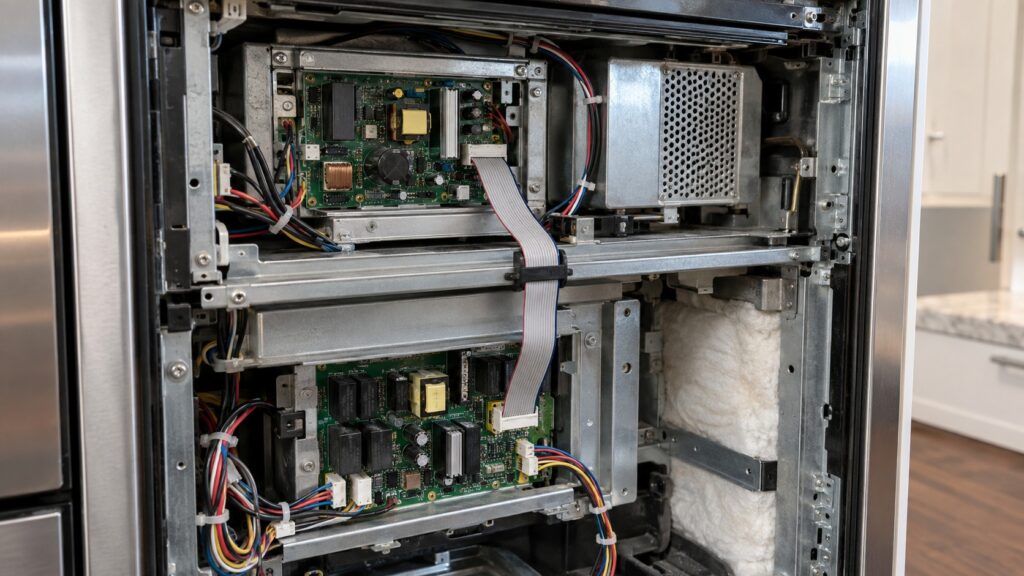
Through a communication link rather than through shared wiring. The panel you touch is a user interface board. It does not switch elements or fire the magnetron itself; it decides what you asked for and sends that to the power board in the relevant cavity, which does the switching. Each board also reports back: temperatures, door states, whether a relay actually closed.
That architecture is why the column can do things two separate appliances cannot, such as refusing to start a self-clean while the microwave is running, or managing the shared cooling fan for whichever cavity needs it. It is also why the conversation between the boards is itself a component that can fail.
What does F6 E4 mean on a KOCE500ESS?
F6 E4 is a microwave to oven communication problem: the two halves of the column have stopped hearing each other. It is the code that belongs specifically to a combination appliance, and on a standalone oven you would never see it.
The symptom is often stranger than a plain failure. A cavity that will not accept a setting, an interface that lights up and then goes blank, a microwave that runs but an oven that will not preheat, or a column that seems to work until one specific function is asked for. Because the interface is shared, a break in the link can make a perfectly healthy oven look dead.
The first move is a full power cycle at the breaker, two minutes off, because a communication fault that was caused by a transient clears and one caused by a connector does not. Compare it with F6 E0, which is a loss of communication with the user interface itself: F6 E0 means the panel is out of the conversation, F6 E4 means the two cavities are.
Why do the sensor codes come in pairs?
Because each cavity has its own temperature probe, and the code tells you which one. F3 E0 is an upper oven sensor open and F3 E2 is a lower oven sensor open. On a double wall oven such as the KODE500ESS those map to the two ovens directly; on a combination column the pairing still exists in the control scheme, which is the clearest evidence that the two cavities are managed as separate systems that happen to share a face.
An open sensor means the probe has gone open circuit and the control has no temperature to work from, so it stops rather than guess. That is a good design decision and a bad evening. There is no user fix: a sensor and its harness sit inside the cavity wall, in a column that is screwed into a cabinet and fed by a dedicated circuit.
Two more codes describe the same cavity from the door side. F5 E1 is a door latch that will not lock, and F5 E2 is a latch that will not unlock, both of which normally appear around a self-clean cycle. F5 E2 is the one that traps dinner behind a locked door, and waiting for the cavity to cool completely is the only thing worth trying before calling.
What does Even-Heat True Convection change in the lower oven?
It adds a third heating element behind the fan, so the air being circulated is heated as it moves rather than simply stirred. A plain convection oven blows air warmed by the bake element around the cavity; a true convection oven warms the air at the fan. The practical result is a cavity that holds a more even temperature front to back, which is what makes multi-rack baking work in a column where the lower oven is the only oven you have.
It also adds a failure mode worth knowing: the convection fan and its element are behind the rear wall, and an oven that browns unevenly with the fan running is a different complaint from an oven that does not heat at all. Our guide on how Even-Heat convection works covers the element and fan arrangement, and uneven heating causes and fixes covers what to check when the results drift rather than stop.
What should you check before calling about a combination column?
- Which cavity. Upper, lower, or both. On a shared interface this is the single most useful thing you can tell a technician.
- The whole column at the breaker. Two minutes off. Both cavities are on one circuit, so this resets everything at once.
- The vent trim. The shared cooling path exits between the cavities. A towel over it or a cabinet trim piece covering it produces heat complaints in both halves.
- The door. A microwave that runs for a second and stops is usually an interlock, not a magnetron; a microwave that is not heating narrows that down.
- The installation. If the column is new, the cutout and the circuit are the first suspects; our wall oven installation and setup guide covers both.
Stop before removing the rear panel of the upper cavity. A microwave high-voltage capacitor holds a lethal charge after the power is off, and it is directly behind that panel. Nothing in the upper cavity is owner-serviceable, and routine care for the lower one is covered in our oven maintenance guide.
We are an independent repair company, not a factory service arm. Pricing starts from a diagnostic visit and we confirm the estimate before any work begins. KitchenAid oven repair covers both cavities of a combination column, and you can schedule a visit online or call 1-844-755-8060 with the code and the cavity it came from.