This guide explains the Kitchenaid Refrigerator Hrs Error: what it means, what causes it, and how to resolve it safely.
Understanding the Kitchenaid Refrigerator Hrs Error
Below, our specialists break down everything you need to know about the Kitchenaid Refrigerator Hrs Error.
Understanding the Kitchenaid Hrs Error
Below, our specialists break down everything you need to know about the Kitchenaid Hrs Error.
What HrS means on your KitchenAid refrigerator
Seeing HrS on the display panel of a KitchenAid refrigerator means the unit’s self-monitoring logic has identified high Resistance Sensor. HrS on KitchenAid refrigerators signals that one or more temperature sensors are returning resistance values higher than the maximum expected for the current temperature, indicating a failing or disconnected thermistor in the sensing circuit. That finding is exactly what triggers the KitchenAid HrS error.
This is one of the more forgiving codes to deal with initially — if connector reseating resolves the high-resistance reading, a breaker reset clears HrS permanently. A drifted or broken thermistor will cause HrS to return regardless of resets. The rest of this guide walks through the symptoms you’d expect to see alongside it, the components most commonly responsible, and what a technician checks before recommending a repair.
Symptoms
A handful of everyday clues usually accompany this code:
- The display shows the HrS code, sometimes flashing or alternating with the temperature readout
- Fresh food or freezer temperatures drift away from the set point
- You may notice unusual fan noise, silence where airflow should be, or warm spots inside the cabinet
- The refrigerator may cycle the compressor more frequently than normal
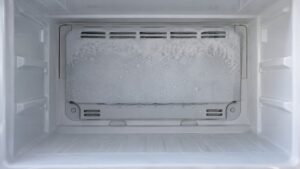
- Ice or frost may be visible in places it shouldn’t be, such as around vents or the evaporator area
Common causes
Root causes for this code fall into a few recognizable categories:
- Partially disconnected thermistor connector shows up often behind this code. One pin in the thermistor connector has backed out slightly, increasing contact resistance and shifting the apparent sensor resistance upward without causing a complete open circuit. This is one you can often rule out yourself before calling anyone.
- Thermistor lead wire with high-resistance intermittent break shows up often behind this code. A hairline conductor break in the thermistor wire creates a series resistance that adds to the sensor resistance, producing a reading that looks like a thermistor that is too cold. Worth ruling this out first since it costs nothing but a little time.
- Thermistor probe aged out of calibration — After years of thermal cycling, the NTC thermistor material can shift its resistance curve upward, causing a systematic high-resistance reading at all temperatures. A homeowner can usually check for this in a few minutes with no special tools.
Troubleshooting steps you can try
Work through these checks in order — each is safe for a homeowner and helps narrow down what is causing the problem on your KitchenAid refrigerator before you call anyone.
- Reseat all thermistor connectors — Turn off the refrigerator at the breaker. Locate the thermistor harness connectors — typically accessible behind the fresh food interior light housing or at the control board behind the lower grille. Disconnect each connector, inspect the pins, and firmly reseat it until it clicks. HrS caused by a partially backed-out connector is one of the few KitchenAid error codes that can be fully resolved by a homeowner with no parts purchase. Always start here.
- Compare display temperature to a reference thermometer — After reseating connectors and restoring power, place an appliance thermometer in each compartment for 30 minutes and compare readings to the display. If the display now matches the reference thermometer within 3°F, the connector was the cause. Allow the refrigerator 90 minutes to stabilize after a breaker reset before comparing temperatures — initial readings after a reset may not reflect steady-state operation.
When to call a technician
Hand the refrigerator over to a qualified technician in these situations:
- Thermistor resistance at known temperature exceeds specification by more than 10%
- Wire continuity test shows resistance above 1 ohm on either thermistor lead
- HrS persists after thermistor replacement — indicates board ADC or reference voltage problem
Since this particular code often clears with a simple reset, give that a try first — but don’t keep resetting past the point where the same problem keeps returning within a day or two. If you’d rather not troubleshoot a KitchenAid refrigerator yourself, schedule a visit with our team, or browse our full error code library for related problems. For manufacturer specifications on your exact model, KitchenAid’s own site at kitchenaid.com is a useful reference, though our technicians are independent specialists and not affiliated with the manufacturer.
Before any appointment, jot down the exact code text, when it first appeared, and what you already tried — that short history lets an experienced technician arrive with the likely part already in hand instead of needing a second visit just to diagnose the problem.