The KitchenAid refrigerator defrost cycle is a short, automatic warm-up that melts frost off the cooling coil so the refrigerator can keep cooling efficiently. A few times a day, the compressor and fans pause, a heater near the coil switches on, the frost melts and runs out through a drain, and the refrigerator returns to normal cooling. You should hardly notice it. When you do notice thick frost, a warm refrigerator or water on the floor, one link in that chain has failed.
What is a defrost cycle in a KitchenAid refrigerator?
A frost-free refrigerator keeps its food cold by passing air over a very cold coil. That coil also pulls moisture out of the air, and the moisture freezes on it as frost. Left alone, the frost would grow into a layer thick enough to block the air, and the refrigerator would slowly lose its ability to cool.
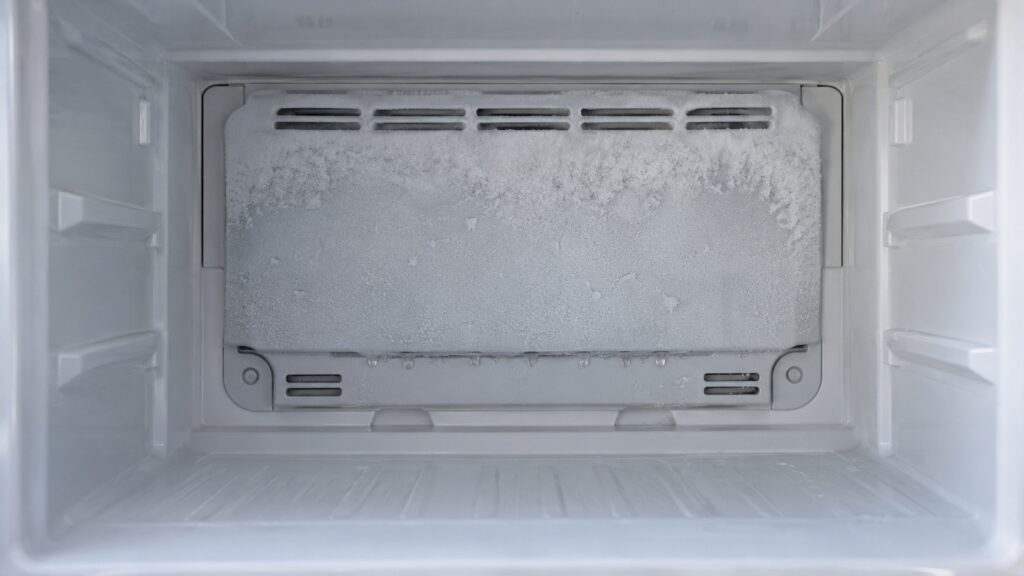
The defrost cycle prevents that. It is the reason a frost-free refrigerator never needs to be emptied and thawed by hand, and it is also the reason that a visible sheet of frost on the back wall of the freezer is a warning sign and not a normal condition.
How does the defrost cycle work step by step?
The sequence is the same on most frost-free KitchenAid refrigerators, even though the parts differ from model to model.
- The control starts a cycle. It decides, based on how long the compressor has run and how the door has been used, that the coil has probably collected enough frost.
- Cooling pauses. The compressor and the evaporator fan stop, so no cold air is produced.
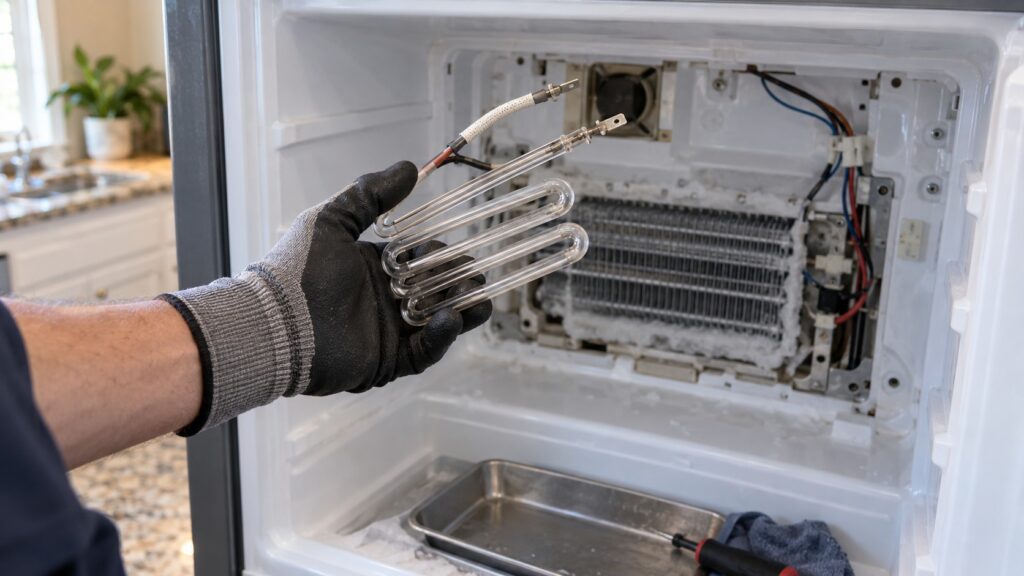
- The heater switches on. The defrost heater warms the coil and the frost melts.
- The sensor reports a warm coil. When the coil has clearly warmed above freezing, the sensor or thermostat tells the control that the frost is gone.
- The heater switches off and cooling resumes. The compressor and fan restart, and the freezer returns to its set temperature.
The control may hold off the next cycle for many hours. Some models adjust the interval to how often the doors open and how humid the kitchen is, so a busy household in summer defrosts more often than an empty house in winter.
How often does it run, and what is normal during it?
The exact interval depends on the model and the conditions, so there is no single number to expect. What you can expect is the experience of one cycle: the refrigerator goes quiet because the fan and compressor are off, you may hear light crackling or dripping as the coil warms and the frost melts, and the freezer air warms by a few degrees. Food in the freezer does not thaw, because the cycle is short and the food stays far colder than the coil.
You might also see a dark display or a brief light change on some models, since the control is busy. That is also normal. What is not normal is a freezer that stays warm for hours, a compressor that runs without stopping or a visible layer of frost that does not clear.
Where does the melted frost go?
The meltwater drips off the coil into a trough, runs through a drain tube and ends up in a shallow pan near the compressor at the bottom of the refrigerator. Warm air from the compressor area evaporates it. The system is designed so that you never see water, and when you do, the drain path is the first thing to suspect.
A drain tube can clog with ice, food residue or debris. When that happens, the meltwater has nowhere to go. It refreezes at the bottom of the freezer, spills over the floor of the compartment or leaks onto the kitchen floor. If you see a frozen puddle under the freezer drawer or a trickle of water at the bottom of the fresh food section, the drain is a likely cause. Our guide to the freezer not freezing problem covers the connected symptoms.
What are the signs that the defrost system has failed?
Because defrost is a chain, the symptoms point to where it broke:
- Thick frost on the back freezer wall or the cooling coil. The heater, the sensor or the control did not complete a cycle, so frost kept building.
- Freezer cold but the refrigerator warm. Frost on the coil blocks the airflow that carries cold air to the fresh food compartment.
- Water or ice at the bottom of the freezer. The meltwater cannot drain, often because the tube is blocked.
- The refrigerator cools for a while and then loses ground. Frost builds up gradually until the airflow is too restricted.
- A temperature sensor code on the display. The control relies on its sensors to run the cycle, so a sensor fault can disrupt everything. See our page on the KitchenAid refrigerator F3 E2 sensor code for what a thermistor fault involves.
A technician can separate those causes quickly by testing the heater for continuity, checking the sensor and confirming whether the control is calling for a cycle. Replacing the wrong part is the main reason these repairs repeat, so testing first matters.
What can you safely do yourself?
Your options are modest, and that is by design, because the heater and control carry power and sit behind panels.
- Check that the door gaskets seal all the way around. A leaky gasket lets humid air in, and the extra moisture builds frost faster than the cycle can clear.
- Keep the vents inside the freezer and fresh food compartments unblocked so air can circulate.
- Do not chip frost off the coil or the back panel with a tool, and do not aim a hair dryer into the cabinet.
- If frost has built up, a full manual defrost can restore cooling for a while: unplug the refrigerator, empty the freezer into coolers, leave the doors open with towels on the floor, and let it thaw fully before restarting. This clears the symptom but not the cause, so if the frost returns within weeks the defrost system needs testing.
For help keeping the coils, gaskets and drain in good shape, read how to maintain your KitchenAid refrigerator, and for a refrigerator that is warm, why a KitchenAid refrigerator is not cooling.
When should you call a technician?
Call when frost returns after a manual defrost, when there is water or ice at the bottom of the freezer, or when the freezer stays warm for hours. Our KitchenAid refrigerator repair technicians test the whole defrost chain, from the heater to the sensor and the drain, so that only the failed part is replaced. We are an independent repair company, not a factory service arm, and we will tell you when a repair is not worth doing. You can book a visit with a note of where the frost appears.