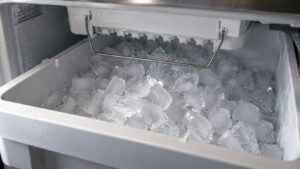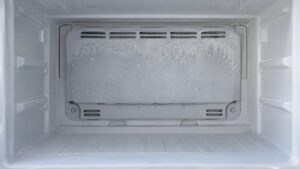

TL;DR: When a KitchenAid refrigerator shows E1 or E2, it is reporting a temperature sensor problem: E1 means the freezer thermistor is reading outside its valid range, and E2 means the fresh food thermistor is. In nearly every case the answer to the repair-or-replace question is repair, because the failing part is a small probe, its wiring or a connector, not the sealed system. Replacing the whole refrigerator makes sense only when it is old and other major parts are also failing.
What do E1 and E2 mean on a KitchenAid refrigerator?
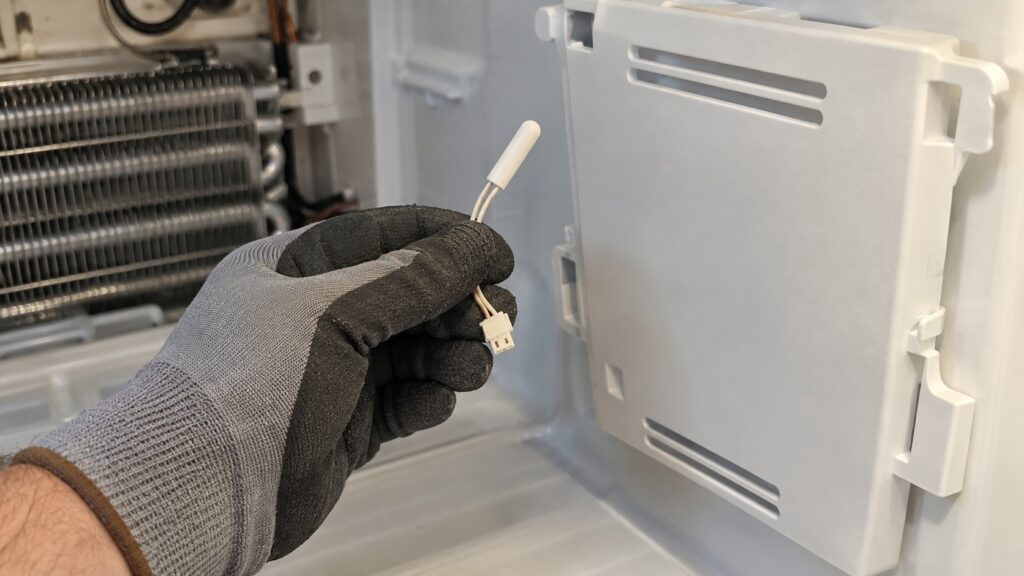
A KitchenAid refrigerator E1 E2 sensor code is the control board telling you it has lost trust in a temperature reading. Both are sensor codes. The control board watches a thermistor in each compartment, a small probe whose electrical resistance changes with temperature. When the reading falls outside the range the board can trust, it raises a code instead of guessing. Our E1 page describes the freezer sensor; the E2 page describes the fresh food sensor. With either one, the refrigerator may fall back to a fixed cooling schedule, which can leave food too warm or too cold without much warning.
That is why the codes matter even when the unit still seems to run. It is also why the question of repairing or replacing comes up so quickly: the refrigerator looks mostly fine, the code looks serious, and the next step is not obvious. You might notice temperatures drifting away from the set point, unusual fan noise or silence where airflow should be, warm spots in the cabinet, or a compressor that cycles more often than normal.
What usually breaks behind E1 and E2?
The list is short and mostly inexpensive in parts. On the freezer side, a failed thermistor, a damaged wire harness (frost and repeated freeze-thaw cycles crack the insulation, and a sharp coil edge can wear a conductor) and, less often, a fault in the main control board’s input circuit. On the fresh food side, the same failed probe, plus two causes specific to French door models: the thermistor lead runs through a flexible harness in the hinge area, where repeated door opening stresses the wire until it cracks, and condensation can reach the connector pins and offset the reading.
A technician typically checks the thermistor’s resistance at 32 degrees Fahrenheit against the expected range of 16,000 to 17,000 ohms, looks at the harness and connector, and only then considers the board. That order matters: replacing a board because a probe went bad is a costly way to learn the probe was the problem.
What can you check yourself before deciding?
- Compare with a reference thermometer. Put an appliance thermometer in the center of the freezer, or on the middle shelf of the fresh food side, for thirty minutes with the door closed. A difference of more than a few degrees from the display points to a sensor that reports inaccurately.
- Look for frost on the freezer sensor. If the probe is visible and buried in heavy frost, a manual defrost may restore accurate readings, because ice insulates the probe. That is a different problem from an electrical failure.
- Check a fresh food connector for moisture. If it is accessible and you are comfortable with it, a dry connector with clean pins removes one common cause. Unplug the refrigerator first.
Do not open sealed panels or probe live wiring. If those checks change nothing, the next step is a technician with a meter.
When is repair the right choice?
Almost always. A thermistor or its harness is a small, replaceable part, and the repair is usually done in a single visit once the cause is confirmed. Compare that with replacing a French door or built-in refrigerator, which means a large purchase, delivery, removing the old unit and, on a built-in, possibly carpentry. Our general refrigerator repair or replace guide gives the broader rules of thumb, and a sensor code is firmly on the repair side of them.
Even a board fault is not automatically a replacement case. If the board’s input has failed after a good probe is installed, replacing the board is still a repair of one part, not of the whole refrigerator. The technician will confirm which before ordering.
When does replacing the refrigerator start to make sense?
Consider replacement when the sensor code is only one item in a longer list. A very old refrigerator that is also losing cooling, has a failing compressor or fan, leaks, or has repeated board problems tends to cost more to keep alive than to retire. Age alone is not the test; a well-kept unit that needs one probe is better value than a new one. We also suggest reviewing your coverage first, using our warranty check before repair or replace guide, because a recent purchase may still have help available.
A code like F3 E2 has its own decision path, as does a refrigerator that is simply warm; see refrigerator not cooling. For sensor codes, our KitchenAid refrigerator repair service can test and replace the probe, and you can book a visit with the model number and the exact code.