This guide explains the Kitchenaid Refrigerator E1 Error: what it means, what causes it, and how to resolve it safely.
This guide explains the Kitchenaid E1 Error 4: what it means, what causes it, and how to resolve it safely.
Understanding the Kitchenaid Refrigerator E1 Error
Below, our specialists break down everything you need to know about the Kitchenaid Refrigerator E1 Error.
Understanding the Kitchenaid E1 Error 4
Below, our specialists break down everything you need to know about the Kitchenaid E1 Error 4.
What E1 means on your KitchenAid refrigerator
Seeing E1 on the display panel of a KitchenAid refrigerator means the unit’s self-monitoring logic has identified freezer Sensor Out of Range. E1 on KitchenAid refrigerators indicates the freezer temperature thermistor is reading outside its valid resistance range. The control board cannot trust the freezer temperature data and may default to a fixed output duty cycle. That finding is exactly what triggers the KitchenAid E1 error.
Unlike simple power-loss alerts, this code points to a real operating condition rather than a display glitch: E1 is a sensor measurement error. A breaker reset may suppress the code momentarily if the thermistor is borderline, but a failed thermistor cannot be reset — only replaced. The rest of this guide walks through the symptoms you’d expect to see alongside it, the components most commonly responsible, and what a technician checks before recommending a repair.
Symptoms
Owners usually notice more than the code itself. Watch for these related signs:
- The display shows the E1 code, sometimes flashing or alternating with the temperature readout
- Fresh food or freezer temperatures drift away from the set point
- You may notice unusual fan noise, silence where airflow should be, or warm spots inside the cabinet
Common causes
Several unrelated problems can trigger this identical readout, so it pays to check them in order:
- Failed freezer thermistor (open or shorted) is one of the more frequent triggers. The NTC thermistor measuring freezer compartment temperature has drifted out of its calibrated resistance curve or failed entirely, returning an invalid signal to the board. A homeowner can usually check for this in a few minutes with no special tools.
- Thermistor wire harness damaged by frost or mechanical wear shows up often behind this code. The thin wiring from the thermistor to the main board has cracked insulation or a broken conductor caused by repeated freeze-thaw cycling or a sharp evaporator coil edge. This is one you can often rule out yourself before calling anyone.
- Technicians also see main control board analog input circuit failure lead to this code. The board’s ADC input that reads the thermistor voltage divider has failed, reporting an invalid reading even with a functional thermistor in place. Left to a specialist, this is usually confirmed with a multimeter or manufacturer diagnostic mode rather than guesswork.
Troubleshooting steps you can try
Work through these checks in order — each is safe for a homeowner and helps narrow down what is causing the problem on your KitchenAid refrigerator before you call anyone.
- Compare the display temperature to a reference thermometer: Place a calibrated appliance thermometer in the center of the freezer for 30 minutes with the door closed. Compare its reading to the displayed temperature. A difference of more than 5°F confirms the thermistor is reporting inaccurately. Check the thermometer at the same time as the display, not before opening the door — door opening changes compartment temperature quickly.
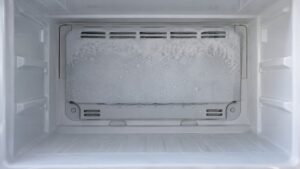
- Inspect the thermistor sensor probe location for frost encasement — The freezer thermistor is typically clipped to the evaporator coil or side wall. If it is visible and encased in heavy frost, a manual defrost may restore accurate readings by freeing the probe from insulating ice. Thermistors encased in ice report a lower temperature than actual because the ice acts as thermal insulation — this is distinct from an electrical failure and clears with defrost.
When to call a technician
Schedule an experienced technician for your refrigerator when:
- Thermistor resistance at 32°F outside 16,000–17,000 ohm range
- Wiring harness shows cracked insulation or broken conductors
- E1 persists after thermistor replacement — indicating board ADC failure
Because this code reflects a real hardware or sensor condition rather than a passing glitch, repeated resets won’t resolve it on their own. If you’d rather not troubleshoot a KitchenAid refrigerator yourself, schedule a visit with our team, or browse our full error code library for related problems. For manufacturer specifications on your exact model, KitchenAid’s own site at kitchenaid.com is a useful reference, though our technicians are independent specialists and not affiliated with the manufacturer.
Before any appointment, jot down the exact code text, when it first appeared, and what you already tried — that short history lets an experienced technician arrive with the likely part already in hand instead of needing a second visit just to diagnose the problem.