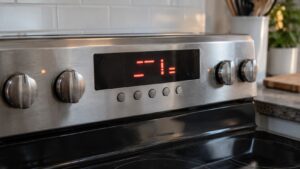
This guide explains the Kitchenaid Range F1 E0 Error: what it means, what causes it, and how to resolve it safely.
This guide explains the Kitchenaid F1 E0 Error 3: what it means, what causes it, and how to resolve it safely.
Understanding the Kitchenaid Range F1 E0 Error
Below, our specialists break down everything you need to know about the Kitchenaid Range F1 E0 Error.
Understanding the Kitchenaid F1 E0 Error 3
Below, our specialists break down everything you need to know about the Kitchenaid F1 E0 Error 3.
What F1 E0 means on your KitchenAid Range
When a KitchenAid range flashes F1 E0, the control board is telling you the range control board detects a checksum mismatch in its EEPROM memory. Stored calibration and cycle data cannot be trusted, so the control locks the oven cavity and prevents operation until the problem is resolved. Technicians typically describe this as eeprom checksum failure.
This particular KitchenAid F1 E0 error exists because the appliance’s designers wanted a clear failsafe rather than silent malfunction. It’s a useful signal, not a punishment — it tells you precisely which subsystem needs attention before you spend money guessing. A five-minute breaker reset clears the code temporarily. If the EEPROM chip has genuinely failed, the code will return within one or two power cycles. A clean session without the code indicates a transient problem.
On KitchenAid ranges, this problem is diagnosed the same way whether the unit is a few months old or well past its first decade of service — the electrical or mechanical signature of F1 E0 doesn’t change with age, only the likelihood of which specific cause applies.
Symptoms
- The control panel displays the F1 E0 error code and refuses to clear with normal button presses.
- Power-cycling the range may clear the display temporarily, but the underlying condition can return.
- Related symptoms can include the specific issue described by “Degraded EEPROM chip on the control board” — the non-volatile memory storing firmware and calibration data has worn out after years of read-write cycles.
- Cooking or heating functions tied to this problem (eeprom checksum failure) are locked out until the code is resolved.
- In some cases you’ll also notice signs pointing toward “loose ribbon cable between the keypad and control board”.
Common causes
Three failure paths typically explain a F1 E0 reading on a KitchenAid range:
- Degraded EEPROM chip on the control board. The non-volatile memory storing firmware and calibration data has worn out after years of read-write cycles. This typically requires a technician to resolve.
- Voltage spike from the household supply. A power surge corrupted the stored checksum value, causing the board to flag every startup verification as a mismatch. This typically requires a technician to resolve.
- Loose ribbon cable between the keypad and control board. An unseated connector causes intermittent data errors that the board logs as EEPROM problems. This is sometimes something you can check yourself first.
Troubleshooting steps you can try
Work through these checks in order — each is safe for a homeowner and helps narrow down what is causing the problem on your KitchenAid range before you call anyone.
- Hard reset at the circuit breaker. Switch off the range breaker for five full minutes to fully discharge the control board capacitors, then restore power and check whether the code clears. Pressing Cancel or flipping the range switch is not sufficient — a breaker-level reset is required to clear EEPROM problems.
- Inspect the ribbon cable connection. After removing the back panel or control console (model-dependent), verify the ribbon cable between the keypad and control board is fully seated with no visible damage. Reconnect any loose connector firmly and restore power before ordering parts — a reseated cable sometimes clears this problem permanently.
When to call a technician
Schedule an experienced technician for your range when:
- Code returns within one use cycle of any reset
- Control board shows visible burn marks, discoloration, or swollen capacitors
Persistent F1 E0 problems on a range are best handled by a specialist with the right parts. Book online, browse the error-code database, or see kitchenaid.com.