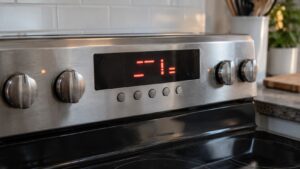
This guide explains the Kitchenaid Range F7 E6 Error: what it means, what causes it, and how to resolve it safely.
Understanding the Kitchenaid Range F7 E6 Error
Below, our specialists break down everything you need to know about the Kitchenaid Range F7 E6 Error.
Understanding the Kitchenaid F7 E6 Error
Below, our specialists break down everything you need to know about the Kitchenaid F7 E6 Error.
What F7 E6 means on your KitchenAid Range
On a KitchenAid range, the appearance of F7 E6 is not random — it is the board’s way of saying the control board detects that the relay for the right rear surface element is stuck in the closed position on electric models. The right rear burner continues to receive power even after a shutoff command, creating a burn and fire hazard. In plain terms, relay stuck — right rear burner is what’s happening behind the scenes.
This particular KitchenAid F7 E6 error exists because the appliance’s designers wanted a clear failsafe rather than silent malfunction. It’s a useful signal, not a punishment — it tells you precisely which subsystem needs attention before you spend money guessing. A breaker reset does not repair welded relay contacts. The right rear element will resume heating immediately when power is restored. Do not restore power until the relay board or control board is replaced.
Symptoms
- The control panel displays the F7 E6 error code and refuses to clear with normal button presses.
- The code returns immediately after every power cycle because the problem is a hardware condition, not a software hiccup.
- Related symptoms can include the specific issue described by “Welded relay contacts on the right rear element relay” — high inrush current during repeated switching of the right rear element has fused the relay contacts, preventing them from opening on command.
- Cooking or heating functions tied to this problem (relay stuck — right rear burner) are locked out until the code is resolved.
- In some cases you’ll also notice signs pointing toward “high-output right rear element drawing excessive inrush current”.
Common causes
Three failure paths typically explain a F7 E6 reading on a KitchenAid range:
- Welded relay contacts on the right rear element relay. High inrush current during repeated switching of the right rear element has fused the relay contacts, preventing them from opening on command. This typically requires a technician to resolve.
- Failed right rear relay on the surface element relay board. The specific relay allocated to the right rear position on a separate SERB has failed open-circuit drive or has contacts that are permanently closed. This typically requires a technician to resolve.
- High-output right rear element drawing excessive inrush current. An oversized or dual-ring right rear element draws more current than the relay was rated for over its service life, accelerating contact welding. This is sometimes something you can check yourself first.
Troubleshooting steps you can try
These diagnostic steps require no special tools and are safe to perform on a range. Complete them in order and note what changes after each one.
- Remove all cookware from the right rear element immediately. As soon as F7 E6 appears and the right rear element is on, remove any pots or pans from that burner position. Do not place cookware on that element again until the range is repaired. A glass-ceramic cooktop retains heat for up to 15 minutes under normal conditions — with a stuck relay the element may stay at full power indefinitely, making the surface extremely dangerous.
- Switch off the range circuit breaker. If the right rear element cannot be controlled from the panel, cut power at the circuit breaker immediately. Do not restore power until the relay board or control board has been professionally replaced. A stuck relay may reactivate the element the instant power is restored — do not assume clearing the breaker and resetting it is a safe workaround for continued use.
When to call a technician
Certain range conditions are not safe or practical to fix yourself — call a professional if:
- Right rear relay confirms stuck-closed with continuity testing by a technician
- Surface element relay board (SERB) requires replacement
- Multiple relay error codes appear across different element positions
If these checks do not clear the F7 E6 code on your range, the problem likely sits in a component that needs a specialist. Book a KitchenAid repair online, browse related error codes, or see product details at kitchenaid.com.