This overview covers Kitchenaid Refrigerators — the lineup, signature technologies, common problems, and upkeep.
Few appliances get judged as harshly on failure as a refrigerator, since a warm unit means spoiled groceries within hours rather than a mild inconvenience you can work around for a day or two. KitchenAid has built its refrigeration lineup around fitting seamlessly into a kitchen’s design first, with the cooling engineering built to hold up quietly in the background.
Understanding the Kitchenaid Refrigerators
Below, our specialists break down everything you need to know about the Kitchenaid Refrigerators.
Built-in versus freestanding
The clearest split in the lineup is between built-in refrigerator columns, designed to sit flush with surrounding cabinetry with a panel-ready front that can be finished to match the rest of the kitchen, and freestanding models meant to stand on their own in a French door, side-by-side, or top-freezer configuration. Built-in columns typically separate refrigeration and freezer functions into two narrower units installed side by side, which gives a kitchen designer more flexibility in layout but means each column has its own compressor and control system to maintain. Freestanding units trade that flexibility for simplicity and, in many cases, larger ExtraLarge capacity interiors designed to maximize usable shelf space within a standard footprint.
FreshFlow and how it works
KitchenAid’s FreshFlow air filtration circulates air through a carbon-based filter designed to reduce odor transfer between stored foods, addressing the common complaint of one strong-smelling item affecting everything else in the fridge. The filtration works alongside the unit’s fan system, which is also responsible for the more basic job of moving cold air evenly between the fresh food and freezer compartments, so a fan failure doesn’t just affect odor control, it directly causes uneven cooling too. Replacing the FreshFlow filter on the manufacturer’s recommended schedule is a low-effort maintenance step that keeps both the odor control and airflow working as intended.
How refrigeration problems show up over time
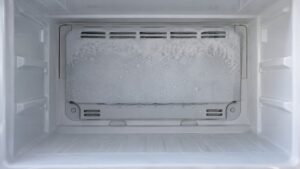
The earliest sign of trouble is usually inconsistent temperature rather than a total failure, with one shelf running noticeably colder than another or the freezer holding fine while the fresh food side drifts warm. That pattern points toward a fan or sensor issue long before the compressor itself is in question, and it’s worth checking for ice buildup around the evaporator coil, which often signals a defrost system that has stopped cycling correctly. Door seals are another slow-failure point, since a seal that’s lost its elasticity lets warm air in gradually rather than all at once, which shows up first as a slightly higher energy bill before it becomes an obvious cooling problem. Our /error-codes/ directory is useful if your display is actively showing a problem, since matching the exact code narrows down which component is worth checking first.
Everyday habits that protect the compressor
Keeping the condenser coils clear of dust, which usually means vacuuming behind or beneath the unit a couple of times a year, is one of the simplest things an owner can do to reduce compressor strain, since a coil caked in dust forces the compressor to run longer to hit the same target temperature. It also helps to avoid overpacking shelves tightly enough to block internal airflow, since KitchenAid’s fan-driven cooling design depends on air actually being able to move between compartments. For anyone deciding between a repair and a replacement on an older unit, our /services/ page outlines what a typical refrigeration repair addresses, and KitchenAid’s site at https://www.kitchenaid.com has full specification sheets for current column and freestanding models if you’re comparing capacity or configuration options.
Getting the model details right
Refrigeration parts are rarely interchangeable across model years even within the same series, since sensor placement, fan design, and control boards change more often than the exterior styling does. Before ordering any part or scheduling any work, confirming the exact model and serial number pays off, and our /models/ directory is built specifically to help match a unit to its correct specifications so any fix addresses the actual configuration in the kitchen rather than a close guess. The serial number, usually printed on a sticker just inside the fresh food compartment, also tells you the production year, which matters when a filter or gasket part number has quietly changed between similar-looking model refreshes.