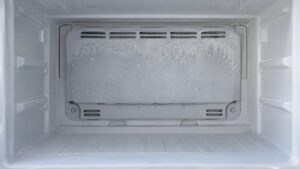

TL;DR: KitchenAid refrigerator F3 E2 means the fresh food thermistor has failed. On its own, this is one of the more affordable refrigerator repairs — a single sensor, not a compressor or a sealed system — and almost always worth fixing outright. The decision to weigh repair against replacement changes only when F3 E2 shows up on a refrigerator that already has other problems, or when it is not the first electronic fault the unit has thrown.
What does F3 E2 mean on a KitchenAid refrigerator?
F3 E2 identifies a failed fresh food thermistor — the temperature sensor that tells the control board how cold the fresh food compartment actually is. The board relies on that reading to decide how hard the compressor and fans need to run to hold your set temperature. When the thermistor fails or its reading drifts outside a plausible range, the board can no longer trust that feedback loop, and it raises F3 E2 rather than continuing to guess. Depending on the model, the refrigerator may keep cooling on a fallback setting while displaying the code, or it may show noticeably inconsistent temperatures until the sensor is replaced.
This is a meaningfully different kind of fault than most refrigerator repair-or-replace decisions revolve around. A thermistor is a small, inexpensive component, and swapping it does not require opening the sealed refrigerant system the way a compressor or evaporator repair does.
Why is F3 E2 usually a straightforward repair decision on its own?
The repair-or-replace calculation for most refrigerator faults weighs the cost of the part and labor against how much of the unit’s expected life is left. A thermistor sits at the cheap, simple end of that spectrum: it is a single low-voltage sensor, it does not require refrigerant handling, and the labor is largely limited to accessing the sensor’s location and confirming the new one reads correctly once installed. Compare that to a sealed-system repair — a failed compressor or a refrigerant leak — where the labor and parts cost climbs steeply and starts to approach a meaningful share of what a new refrigerator would cost. A thermistor repair does not get close to that threshold on almost any KitchenAid refrigerator model, which is why F3 E2 in isolation points toward repair far more often than toward replacement. Parts availability reinforces that math: thermistors are a common, widely stocked component across most KitchenAid refrigerator lines, so a repair rarely stalls waiting on a backordered part the way a specialty compressor or board sometimes does.
When does F3 E2 change from a simple repair into a replacement conversation?
The code itself does not change; the context around it does. If F3 E2 is the second or third electronic fault a particular refrigerator has thrown within a relatively short span, that pattern suggests the control board or its wiring harness may be degrading more broadly, and a thermistor swap might only address the most recent symptom rather than the underlying trend. Similarly, if this refrigerator has already had a compressor, evaporator or sealed-system repair in the past, adding a thermistor fault on top of that history is worth pausing on — not because the thermistor repair itself got more expensive, but because it may be one more sign that the unit as a whole is reaching the point where further faults become likely.
Age matters too, though less than the fault history does. A thermistor failure on a refrigerator well past a typical service life, especially paired with other minor issues — a door seal that no longer holds well, a compressor that runs longer than it used to — is a reasonable point to get a broader assessment rather than treating the sensor in isolation.
How does a technician confirm F3 E2 is actually the thermistor and not something else?
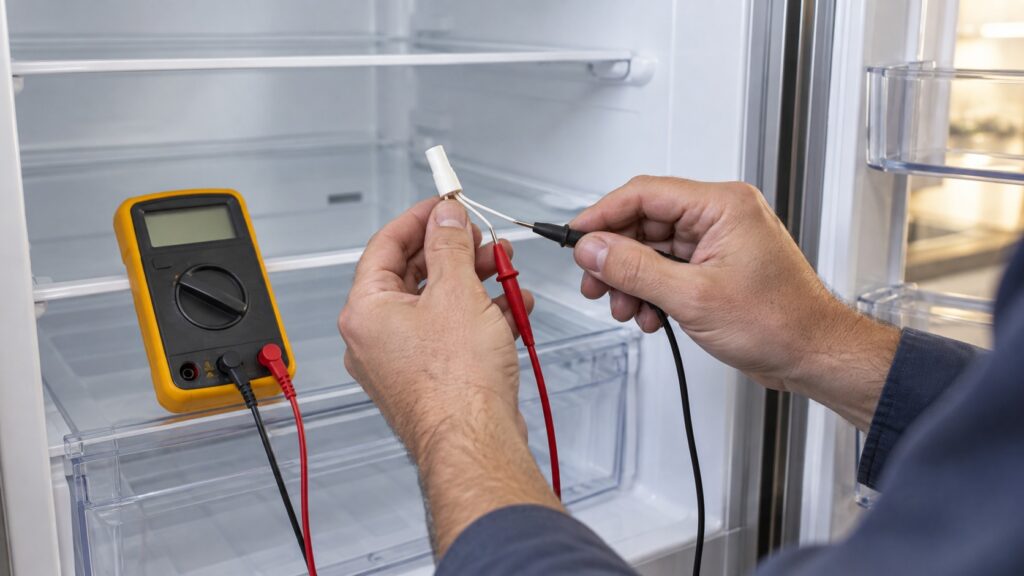
Because the fresh food and freezer compartments each have their own thermistor on most models, and because a wiring or connector issue can sometimes mimic a sensor failure, the correct diagnostic step is testing the thermistor’s resistance directly rather than replacing it on the code alone. A thermistor that reads within its expected resistance range at a known temperature is functioning correctly, which shifts the search toward the wiring harness or the control board’s sensor input circuit instead. This confirmation step is what keeps a straightforward repair straightforward — replacing the wrong part on an F3 E2 code does not clear the fault and adds an unnecessary cost on top of the real fix. It also takes only a few minutes once the sensor is accessible, which is why skipping it to save time rarely pays off.
What can you check yourself before booking a repair for F3 E2?
- Note whether the refrigerator is still cooling adequately despite the code — this affects how urgent the repair is, though it does not change the recommended fix.
- Check for any other active codes or recent repair history on the same unit, since that context is exactly what shifts this from a simple repair into a broader conversation.
- Avoid repeatedly power-cycling the refrigerator hoping the code clears — a genuinely failed thermistor will not resolve itself, and cycling power repeatedly does not help diagnose it.
What is the bottom line on F3 E2?
Treat F3 E2 as a routine, affordable refrigerator repair unless it arrives alongside a history of other faults or a refrigerator already near the end of its typical service life. For a wider look at how to weigh refrigerator age and repair history in general, see our guide to refrigerator repair or replace, and if your unit is showing temperature problems beyond this one code, our guide to refrigerator not cooling covers the broader set of causes. Our technicians confirm the thermistor reading before replacing anything through KitchenAid refrigerator repair. Schedule a visit if your refrigerator is showing F3 E2.