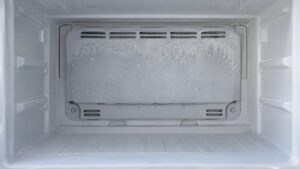

PF stands for power failure. The kitchenaid refrigerator pf code, and the same two letters on a KitchenAid oven, range, cooktop, microwave, dryer, freezer or wine refrigerator, all report one thing: the control board lost line voltage while it was running and has restarted. PF is a notice, not a fault. Nothing inside the appliance has broken, and on most of these machines the letters clear the moment you press a key or restart the cycle.
What does the PF code mean on a KitchenAid refrigerator?
On a KitchenAid refrigerator the letters PF appear on the dispenser or interior display after power has been restored. The control board keeps a small amount of memory through an outage, notices that it started up cold rather than from a normal state, and posts PF to tell you the cabinet was unpowered for a while. The code does not say how long. It does not say whether the compartments stayed cold. It says only that the interruption happened, and it stays on the display until somebody acknowledges it.
That is the whole meaning, and it is worth being precise about, because the kitchenaid refrigerator pf code sends more people looking for a failed part than almost any other message these appliances show. There is no PF component. There is no PF sensor. Pressing and holding the appropriate pad, or opening and closing the door on some models, clears it.
Which KitchenAid appliances show a PF code?
Eight of them, and the wording on each is slightly different for a reason. Refrigerators, freezers, ovens and ranges describe a power failure detected. Cooktops, microwaves and wine cabinets describe a power failure notification. The first group was doing something that the outage ruined, so the appliance treats the event as information you need. The second group simply lost its clock and its settings.
The practical reading is that PF ranks itself by what the appliance was in the middle of. A wall oven eleven minutes into a self-clean and a microwave sitting idle both post PF, and only one of those is worth a second thought.
Why does PF matter more on a freezer than on a dryer?
Because the appliances keep different things at risk. A KitchenAid dryer that loses power mid-cycle has a drum of damp laundry in it. Restart the cycle and nothing is lost. A freezer that lost power has a compartment of food that has been warming for an unknown number of hours, and the code cannot tell you how many.
Use temperature, not the display, to make that call. A freezer holding food that is still hard and still carries ice crystals refroze or never thawed, and the load is fine. Food that has softened through to the middle should be judged on its own. If the freezer also posts a temperature complaint after the PF is cleared, the outage is no longer the story and the cabinet itself needs looking at.
The habits that shorten the recovery are the ordinary ones covered in our guide to maintaining a KitchenAid refrigerator: a clean condenser, a sealing gasket, and doors that stay shut while the cabinet catches up.
What should you do the first time PF appears?
- Clear it and note the time. Press the pad the display indicates, or open and close the door. Write down when you saw it. The date is the only record of the outage you are going to get.
- Restart whatever was running. A timed bake, a delay start, a wash cycle and an ice harvest all abandoned themselves. None of them resume.
- Check the cold appliances before the hot ones. Refrigerator and freezer first, because they are the only two where the outage may have done real damage.
- Reset the clocks. The microwave and the range will have lost the time of day, and on some models a lost clock blocks a timed cook.
- Look outside the kitchen. If clocks elsewhere in the house are also flashing, the utility interrupted the supply and no appliance needs attention at all.
Why does PF keep coming back when the power has not gone out?
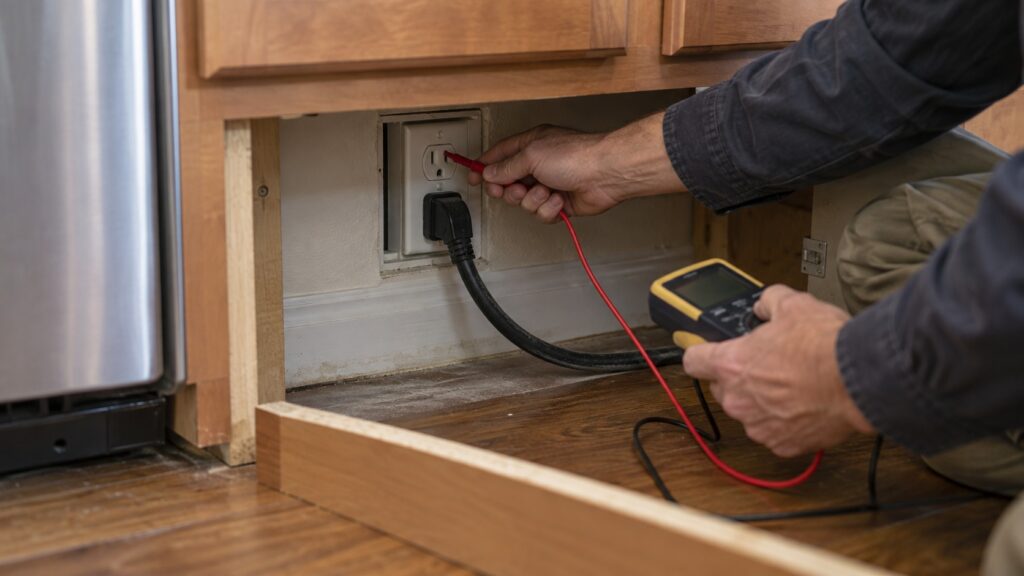
This is the version of PF worth taking seriously, and it is the reason the code is in this glossary rather than in a list of harmless messages. When a single appliance posts PF repeatedly while nothing else in the house resets, the interruption is happening between the panel and that appliance. The usual causes are a loose neutral or line connection in the receptacle, a worn outlet that no longer grips the plug, a shared branch circuit that sags when a large load starts, a breaker that is beginning to fail, or on a range or dryer a cord terminal that has loosened under the strain of a 30 or 40 amp draw.
Those are not appliance repairs. A receptacle that lets go under load is an electrical problem, and it is the kind that gets worse. Stop at the point where the work means opening a wall box, a terminal block behind a range, or the cord entry on a dryer, and bring in an electrician instead. The related messages, and how a fault differs from a notice, are laid out in our glossary of KitchenAid error codes.
When is a PF code a reason to call a technician?
PF alone almost never is. Call when PF has been cleared and comes back within a day without a household outage, when a refrigerator or freezer posts PF and then will not return to temperature, when a range or dryer posts PF along with a burning smell or a warm cord, or when clearing it does nothing at all and the letters stay on the display through a full power cycle at the breaker. That last one means the board is not accepting the acknowledgment, which is a control problem wearing a power failure label.
We are an independent repair company, not a factory service arm. Pricing starts from a diagnostic visit and we confirm the estimate before any work begins. KitchenAid refrigerator repair and KitchenAid oven repair both cover control boards and power circuits, and you can schedule a visit online or call 1-844-755-8060 with the date the code first appeared.