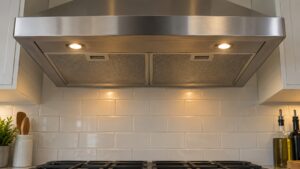
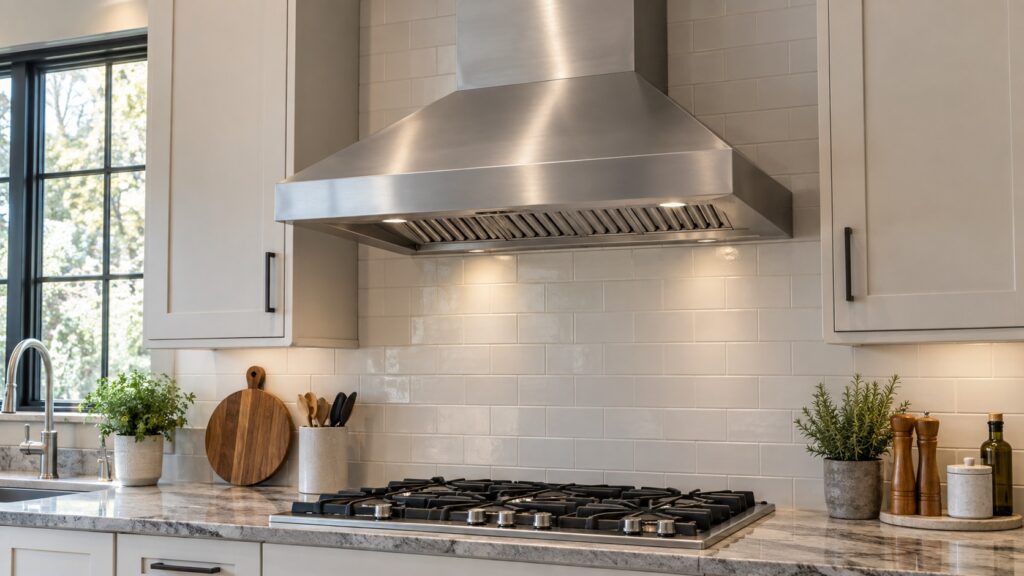
TL;DR: A KitchenAid ducted range hood, such as the KVWB600DSS or KVWB606DSS wall-mount insert, only performs at its rated CFM if the duct run is sized correctly — undersized or overly long ducting is the single most common reason a new hood sounds loud but does not clear smoke or steam. Get the duct diameter, run length, elbow count and make-up air requirement right before the hood is mounted, because most of it is much harder to fix afterward.
Why does duct sizing matter more than blower power on a KitchenAid range hood?
A KitchenAid ducted insert’s rated CFM is measured under close to ideal conditions — a short, straight run with a generous outlet. Every foot of duct, every elbow and every restriction at the termination adds static pressure that the blower has to work against, and the airflow that actually leaves the building drops as that pressure rises. A hood rated at 600 CFM pushed through an undersized or overly long run can deliver well under half of that in practice, while running louder because the motor is working harder against resistance it was never sized for. The result feels like a hood problem — noise without capture — when the actual cause is entirely in the ductwork installed around it.
This is why two installations of the identical KitchenAid model can perform very differently in two kitchens. The hood itself is the same part; the duct run connecting it to the outside is not, and it is the duct run that decides what the kitchen actually experiences.
What duct diameter does a KitchenAid ducted range hood need?
Use the outlet size stamped on the hood’s own installation instructions, not a duct size left over from a previous hood or a smaller hole already cut in the wall. Reducing to a smaller duct anywhere along the run — even for a short transition piece — throttles the entire system down to that narrowest point, the same way a kinked hose limits water flow regardless of how wide the rest of the hose is. If the existing rough-in is smaller than the new hood calls for, resize the duct during installation rather than adapting the hood down to fit it.
How much does duct length and elbow count actually cost in performance?
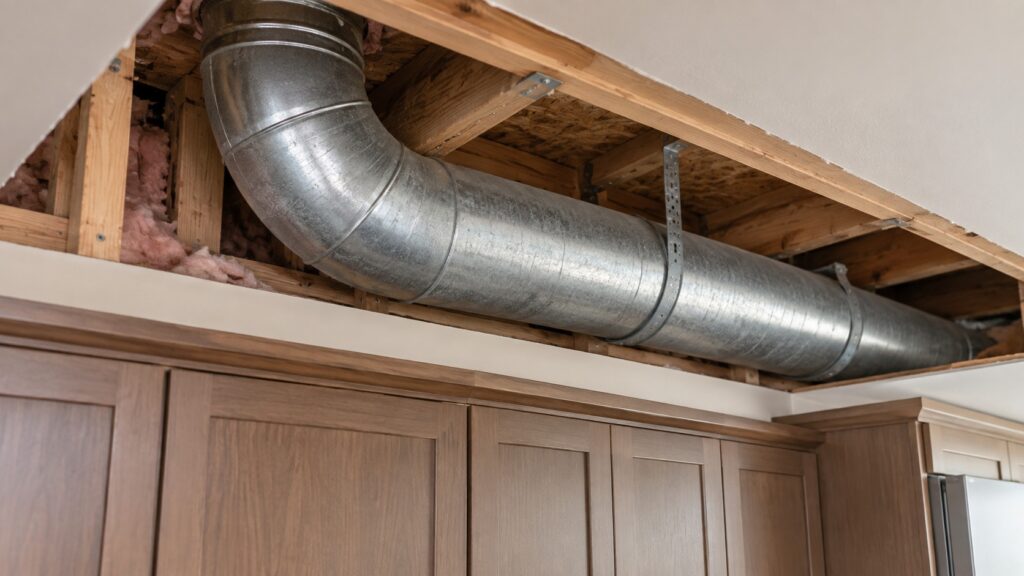
Straight duct and elbows do not cost airflow equally. A long straight run loses some capacity gradually; each elbow loses capacity all at once, at a rate that adds up faster than most people expect. A run with three or four elbows squeezed into a tight ceiling cavity can lose more effective CFM than a much longer but straight run would. When planning where the hood sits relative to the exterior wall or roof, minimizing elbow count is usually worth more than minimizing total distance. Where an elbow cannot be avoided, a smooth long-radius elbow performs measurably better than a tight stamped one.
Rigid metal duct outperforms flexible duct on every one of these installations. Flexible duct’s ribbed interior adds friction the smooth wall of rigid duct does not have, and a flex run that sags or kinks behind a cabinet can quietly cut airflow by more than a poorly placed elbow would. Where rigid duct will not physically fit a particular transition, keep that flexible section as short as possible and pull it fully straight before securing it.
Does a KitchenAid range hood installation need make-up air?
Many building codes require a make-up air system once a kitchen exhaust hood’s rated capacity crosses a set CFM threshold, because a powerful hood pulling that much air out of a tightly sealed house can depressurize the space enough to affect combustion appliances or pull air back down other vents. Whether this applies to a specific KitchenAid model depends on its rated CFM and the local code where the house sits, and that is a determination to make before the rough-in, since retrofitting a make-up air damper after drywall and cabinets are finished is a far larger job than including it during the original installation.
What termination details are worth getting right the first time?
The wall or roof cap at the end of the duct run needs a damper that opens freely once the hood is running and closes fully when it is off, sized to match the duct rather than to match whatever cap opening already exists on the house. A damper that only opens partway under normal airflow behaves exactly like an undersized duct: it adds resistance the blower has to overcome for the life of the hood. Termination location matters too — placing the outlet where wind commonly blows directly into it can push back against the damper and measurably reduce net airflow on breezy days.
What should you check after a new KitchenAid range hood is installed?
- Confirm airflow at the cap, not just at the hood — a hood that sounds strong at the control panel but shows weak airflow at the exterior termination has a duct-run problem, not a hood problem.
- Check the damper closes fully when the hood is off, to keep outside air and pests from entering through the vent.
- Listen for a change in sound over the following weeks — a new whine or increased noise at the same speed setting often signals a duct connection that has come loose rather than a hood defect.
Meeting KitchenAid range hood venting requirements before the hood is mounted avoids the two most common complaints owners bring in afterward: a hood that never seems to clear the kitchen and a hood that seems unusually loud for its rated CFM. If your existing KitchenAid range hood has always seemed underpowered, that is worth investigating before assuming the unit itself is at fault — see our guide to range hood fan and light problems for a broader look at hood performance issues, or start from our full range hood installation and setup guide if you are planning a new install. Our technicians can also inspect an existing duct run as part of a KitchenAid range hood repair visit. Schedule a visit if your hood is already installed and not performing as expected.