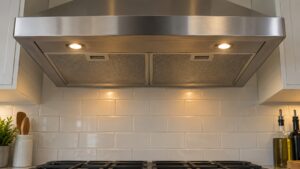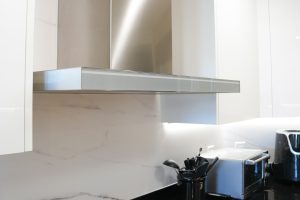

Repairing a KitchenAid range hood is generally the right move for issues involving the fan motor, the lighting, the control switches, or the grease filters, all of which are common wear items with straightforward, affordable fixes. Replacement becomes more sensible when the hood’s blower assembly has failed entirely on an older unit, when ductwork problems point to a bigger ventilation issue than the hood itself, or when you are already considering a kitchen renovation where hood capacity and style might change anyway.
Understanding the Kitchenaid Range Hood
Below, our specialists break down everything you need to know about the Kitchenaid Range Hood.
What a Range Hood Actually Does and Why It Matters
A range hood’s core job is pulling smoke, grease particles, moisture, and cooking odors out of the kitchen, either venting them outside or filtering and recirculating the air depending on the installation type. When a hood stops working properly, it is not just a comfort issue — over time, inadequate ventilation lets grease and moisture accumulate on cabinetry and walls, and in the case of gas ranges, it can also mean combustion byproducts linger in the kitchen air longer than they should. This makes range hood repairs worth addressing promptly rather than letting a weak or non-functioning hood run in the background of daily cooking.
Common, Affordable Repairs
The most frequent range hood issues involve the fan motor slowing down or failing, LED or halogen lighting burning out, control switches sticking or failing, and grease filters becoming so saturated that airflow drops noticeably even with the fan running. All of these are typically quick, affordable repairs. Grease filters in particular should be cleaned regularly, and persistent low airflow that does not improve after a thorough filter cleaning is a good sign that the motor or ductwork deserves a closer look rather than the filters being the culprit.
When Ductwork Is the Real Problem
Sometimes a range hood that seems to be underperforming is not actually broken — the ductwork venting it to the outside may be crushed, disconnected, or clogged with years of accumulated grease. This is a common issue in kitchens where ductwork runs through tight spaces or was installed without enough attention to duct diameter and length. Fixing a ductwork issue is a different job than repairing the hood itself, but addressing both together is important, since even a brand-new hood will underperform if it is fighting restricted ductwork.
Blower Assembly Failures and Replacement
The blower assembly, which houses the fan motor and blades, is the most expensive component in most range hoods, and a full blower failure on an older unit is often the point where replacement starts to look more attractive than repair. This is especially true for hood styles, since range hood design trends and available features change over the years, and a full replacement gives you the chance to upgrade to a quieter, more powerful, or better-styled unit rather than restoring an older hood to its original capability.
Noise Levels Can Also Drive the Decision
Beyond airflow performance, an aging range hood motor often becomes noticeably louder over time as bearings wear, even if it is still technically pulling air effectively. If noise has become bothersome enough that you avoid running the hood on higher settings, that is a legitimate factor in the repair-versus-replace decision, not just outright failure. Newer range hood motors are often meaningfully quieter at comparable airflow ratings, so if you are already facing a moderately priced motor repair on an older, noisy unit, it is worth weighing whether a full replacement might deliver a noticeably better day-to-day experience for a similar total cost.
Getting the Right Diagnosis
A technician can determine quickly whether your airflow or noise issue is coming from the hood itself, the ductwork, or simply neglected filter maintenance, which changes the recommended fix substantially. For related kitchen ventilation and appliance decisions, see our microwave repair-or-replace guide, since many over-the-range microwaves include integrated ventilation, and our range repair-or-replace guide for the cooking appliance underneath. Current KitchenAid range hood models and ventilation specifications are available at kitchenaid.com.