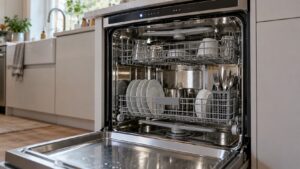
A KitchenAid dishwasher model KDFM404KPS is a 24-inch front control machine with a 360 degree Max Jets third rack, a 44 decibel sound rating and a PrintShield finish, and the thing worth knowing before you look up a single fault is that KitchenAid dishwashers speak two separate code languages. One is a pair of numbers separated by a hyphen, from 1-1 to 8-1. The other is an F number with an E number after it. They are not translations of each other, they do not overlap, and which one your machine uses depends on what kind of display it has.
Which code system does the KDFM404KPS use?
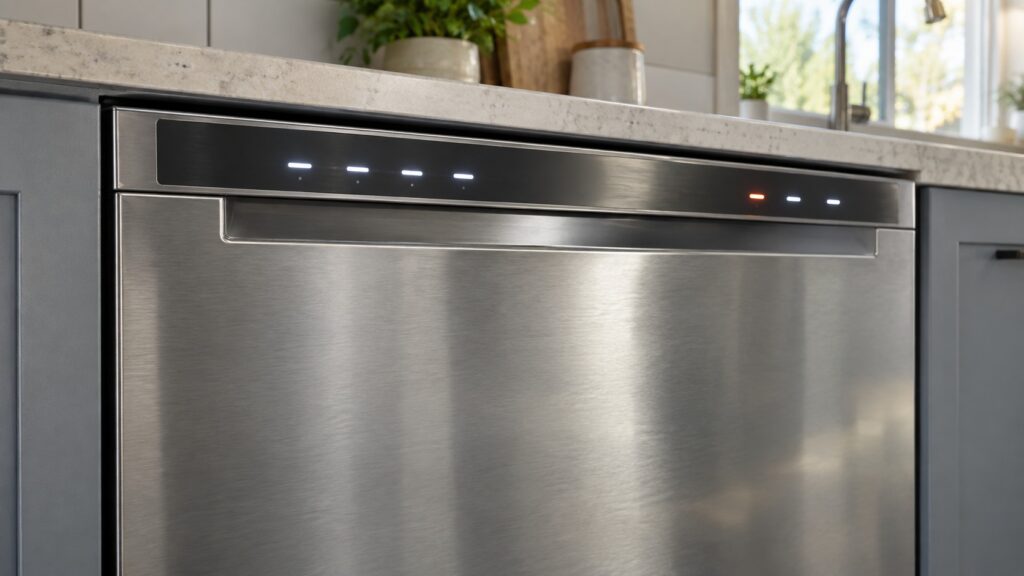
Look at the panel, not the model number. If the machine has a digital display that can show characters, it reports F and E pairs. If it has only status lights and a set of cycle pads, it reports the hyphenated numbers, and it reports them by blinking rather than by printing them.
That second part catches people out. On a light-only machine there is nothing to read, so the fault has to be counted: a group of flashes, a pause, a second group of flashes, a longer pause, then the pattern repeats. The first group is the number before the hyphen and the second group is the number after it. Five flashes, pause, one flash means 5-1, the door latch. Count it three times before you trust it, because a miscount sends you to a completely different component.
What do the drain codes mean, and why are there two of them?
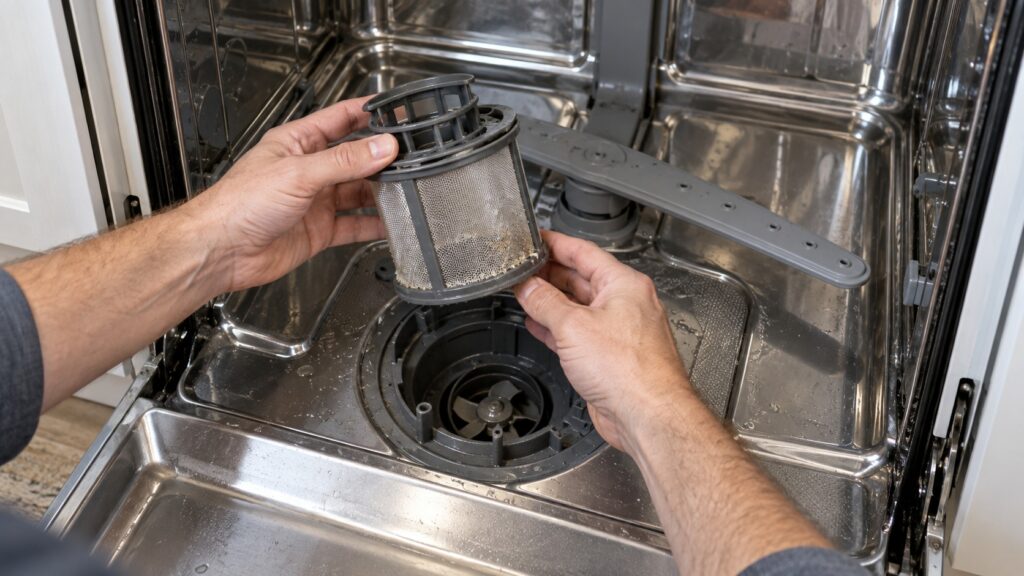
8-1 on a light machine and F9 E1 on a display machine say the same thing in different dialects: water was still in the tub when the drain step ran out of time. That is the most common fault on any dishwasher and the one most often fixed without a technician.
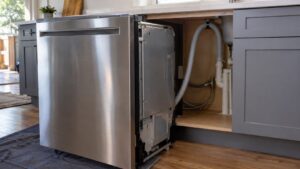
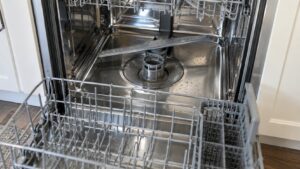
Work outward from the tub. Lift out the filter assembly and rinse it, then reach into the sump and feel for a seed, a shard of glass or a fruit label wrapped around the impeller. Check the drain hose where it leaves the machine for a kink pressed in by a trash can in the cabinet below. Then check the sink end, which is where most of these actually live: a new garbage disposer whose knockout plug was never punched out, or an air gap packed with debris, will stop a perfectly healthy pump every time. Our guide on a KitchenAid dishwasher that is not draining walks that sequence in order, and cleaning the filter covers the part of it you should be doing anyway.
What do the fill and overflow codes mean?
Four codes describe water going in, and they split into two pairs. 6-1 and F6 E1 are the tub not filling: no water arriving, or not enough of it within the window. Start at the supply, because a shutoff valve that was closed during a sink repair and never reopened is the leading cause, followed by a kinked inlet line and a clogged inlet screen.
6-2 and F8 E1 are the opposite, and they are the ones to take seriously. The overflow float has detected too much water in the tub, so the machine stopped the fill and, on most models, started the pump to protect the floor. An overflow code is a leak until proven otherwise. Shut the water off at the valve under the sink before you run it again, and look for standing water in the base pan.
What do the heating and sensor codes mean?
2-1, 4-1 and F3 E1 are all about wash water temperature, from three different angles. 2-1 is the water temperature sensor no longer returning a valid reading, so the control is blind. 4-1 is the machine failing to heat the water in the time it expects, which is a heater or a supply problem rather than a sensor one. F3 E1 is the wash thermistor reading out of range on a display machine, and the description on its own page is worth repeating: this is often wiring or the sensor, not a heating failure at all.
The practical difference matters. A dishwasher with a sensor fault often still washes; one that genuinely cannot heat leaves dishes filmed and plastics wet. That second symptom overlaps heavily with drying complaints, and if the dishes come out clean but damp the cause is usually elsewhere entirely, which is what our guide on a KitchenAid dishwasher not drying is for.
What do 7-1, 5-1, 1-1 and F2 E2 mean?
7-1 is the diverter, the motor and valve that steer water between the lower arm, the upper arm and the third rack jets. On a machine like the KDFM404KPS, whose third rack has its own dedicated jets, a diverter that stops switching shows up as one rack coming out clean and another untouched.
5-1 is the door latch switch failing to confirm the door is closed. Before assuming a switch, look at the latch strike and at anything on the upper rack standing proud enough to hold the door a fraction open.
1-1 is a control board memory problem that stops cycles from finishing, and F2 E2 is the control seeing a keypad button held down that nobody is holding, usually moisture behind the membrane. On a front control panel, steam escaping from a door opened immediately at the end of a cycle is the most common way that moisture gets in. Let the machine sit five minutes before opening it.
What can you safely do yourself?
Filter cleaning, the drain hose and sink end, the supply valve, the latch strike and a two-minute power cycle at the breaker are all owner work, and between them they clear a good share of the codes above. Stop at the door lock assembly, the heater terminals in the sump and the inlet valve. Those are where mains wiring and the water circuit meet inside this machine, and an overflow code means there is already water somewhere it should not be.
We are an independent repair company, not a factory service arm. Pricing starts from a diagnostic visit and we confirm the estimate before any work begins. KitchenAid dishwasher repair covers pumps, diverters, thermistors and control boards, and you can schedule a visit online or call 1-844-755-8060 with the code, or with the flash count if your panel has no display.