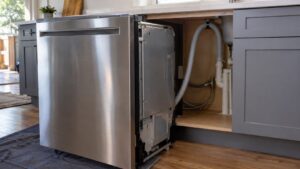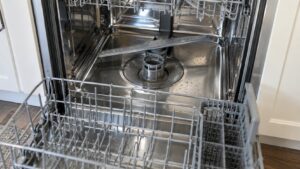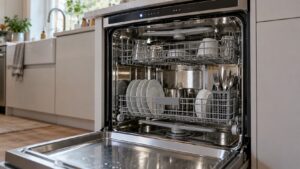

KitchenAid dishwasher terms come up on spec sheets, on the control panel and in every service conversation, and most of them name a system rather than a setting. ProWash, ProDry, AquaSense, third rack, PrintShield — each points at specific hardware or a specific behavior, and knowing which is which turns a vague complaint into a booked part. This glossary covers the names that matter, with what each changes for an owner.
Cycle names
ProWash. A sensing cycle rather than a fixed program. Soil sensors read how dirty the water is and the machine adjusts: a rack of lightly used glasses gets a short, gentle treatment and a load of baked-on casserole dishes gets a longer, hotter one. Two practical consequences. Cycle length varies from wash to wash, and that is correct behavior rather than a fault. And a machine that suddenly runs very long every time is worth investigating, because it may be sensing soil that is really a dirty filter recirculating debris.
AquaSense. A cycle option on certain models. For diagnosis the useful fact is what a poor result on it means: clogged spray arms, a failed diverter that routes water between the arms, or a heating element that no longer reaches wash temperature. Those three are checked in that order.
Heavy, Normal, Express. Fixed cycles with set expectations. Choosing Express for a genuinely dirty load and then reporting poor cleaning is one of the most common service calls that turns out to be a settings conversation.
Drying names, which cause the most confusion
ProDry. An active drying system: heat and air movement working after the final rinse, rather than relying only on the heat the dishes hold. It handles plastics better than passive drying, and it is the reason two otherwise similar machines can perform very differently on a load of storage containers.
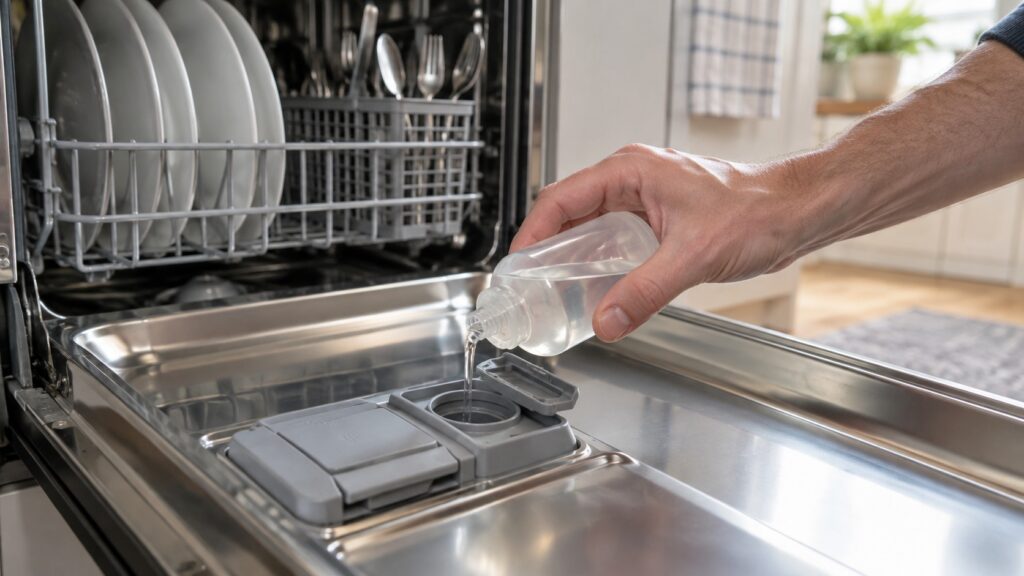
Rinse aid. Not a marketing name but worth listing here, because no drying system works properly without it. Rinse aid changes how water beads and sheets off a surface. An empty dispenser is the single most common cause of “the drying has stopped working.”
Heated dry versus fan dry. Two different approaches, and a control panel that offers a boost option is offering more heat rather than a different mechanism. If drying has degraded on a machine that used to be fine, check rinse aid first and a heating fault second — our guide on dishes that come out wet covers that sequence.
Sani rinse. A high-temperature final rinse offered on many machines. It adds time and heat, it is useful after handling raw meat or when someone in the house is ill, and it is hard on delicate plastics. Treat it as an occasional tool rather than a default, and expect a longer cycle whenever it is selected.
Delay start. A scheduling feature, not a cycle. It is worth mentioning because a machine that “starts by itself in the night” is almost always a delay timer that someone set and forgot, and that call comes in more often than any genuine control fault.
Hardware names
The diverter deserves attention because its failure is so easy to misread: one rack comes out clean and another does not, which sounds like a spray problem and is really a routing problem. Cleaning arms that were never blocked will not fix it.
Numbers on the panel and on the plate
The model number identifies the machine far better than any feature name — a KDTE number and a KDFS number are different builds with different racks and different part lists, even when the features sound the same. It is printed on the door edge, visible when the door is open, and it belongs in any parts conversation.
Decibel ratings turn up in the same descriptions and describe noise rather than performance. A quieter machine is better insulated; it does not wash better, and a machine that has become louder has usually developed a genuine fault rather than lost its insulation.
Using the vocabulary in a service call
“The third rack comes out dirty while the other two are clean” names a jet or an arm. “Plastics stay wet since we ran out of rinse aid” names a consumable. “ProWash now runs three hours every time” names a sensing question that usually ends at the filter. Each of those books a different visit, and two of them can be solved on the phone.
The alternative — “the dishwasher does not work properly” — covers a wash system, a drying system, a filter, a diverter and a control. Naming the system is the single most useful thing an owner can do, and it costs nothing. Routine care is in our guide on dishwasher maintenance.
One more term matters when you buy detergent rather than parts: the dispenser. Its lid opens partway through the cycle, which is why a tablet thrown loose into the tub dissolves during the pre-rinse and is gone before the main wash begins. Load the dispenser, keep the path in front of it clear when you load tall items, and the machine gets its detergent at the moment the cycle was designed around.
When to call
Call when one rack is consistently dirty after the arms and filter have been cleared, when the machine will not reach wash temperature, when a cycle stalls or repeats, or when water remains in the sump after a cycle. Diverters, heaters, pumps and boards are not owner territory, and a leak into cabinetry is expensive to ignore.
We are an independent repair company and not a factory service arm. Pricing starts from a diagnostic visit, and we confirm the estimate before any work begins. KitchenAid dishwasher repair covers pumps, diverters, heaters, sensors and controls on built-in and panel-ready machines, and you can schedule a visit online.